

Why Nobody Cares About Your Well-Crafted About Us Page (Not Even You)
A mini tutorial on how to use your "About Us" page to get people eager to buy from you.
[ short answer ]
What should go on an About Us page?
Your reader's problem, not your founding date. Lead with what's bothering them right now, show you understand their concerns, then promise the result they want. Only after that should you talk about yourself and how you help. Visitors care about what they want first. Meet that need and they'll start caring who you are.
You probably have an About Us page, right?
Does it talk about when you were founded, a cute mission statement and a well-crafted promise of your high-quality service?
I knew it!
Here's the tea. A dramatic way of saying the 4-1-1, the low down and you're about to know now. Sorry.
That kind of fluff writing will get you nowhere quick because you missed a crucial factor. Nobody cares. Now before you stop reading or click off my post due to the direct approach I'm taking here, hear me out. I'm speaking in the best interest of your future profits, so that, people actually give a damn about what's on that (About Us) page and are eager to buy from you.
If it bores even you and your mind starts trailing off to where you could go eat for dinner (because you are not cooking tonight)...You should hit the delete button and brew some fresh tea. Did you like what I did there?...Carrying on. Learning about you or your company is the last thing your readers want to do.
Why? Because they're selfish.
I would compare it to my 4-year old daughter, who I prompt to replace, silence with "Thank You"'s after receiving her favorite treat and instructing her to stop, starting sentences with "I want".
It drives me nuts!
I'm training her to be a well-mannered member of society with a charming personality but she only cares about what she wants first. Her not caring about my life lessons doesn't diminish the value. It's just harder to hear it when you can clearly see --they're salivating at the side of their mouth.
That want needs to be handled.

Otherwise, good luck getting across any well-meaning message you want to stick.
Am I saying grown toddlers live among us? Yes, in an indirect way I am but what I'm also saying is leave your agenda off the table (just for a minute), until you give them what they came for.
Then you can prompt the please and thank you's and fulfill more than just their immediate want. This is how you hook readers into your message with little to no effort and get them caring about who the hell YOU are too.
Here's What You Do:
CALM THE TANTRUM 😭
And lead with their immediate pain.When you do this first --it grabs their attention. It suggests, you get where they may currently be and you are the one who could potentially help.
ADDRESS THE POUT 😩
(No matter how foolish)
Here's where you take an interest in your reader's concern. You know when you've been talking your head off about the idiot jerk that cut you off this morning and they're like "I bet he interrupted you during your favorite song and it threw you off?" And you're like "YES! It messed up my whole morning."
Just imagine how much reassured you'd feel, knowing they're on your side?
PINKY PROMISE YOUR HAPPY-END-RESULT 😍
Once you've clearly defined the reason behind their tantrums and gotten to the bottom of their pout. It's way easier to convince them of your cherry-flavored cough syrup solution. You've planted the roots for them to start caring about who you are, by showing you care about where they are.
Their desires are met and you can now finally, start talking about yourself (how you help).
Take another glance at your About Us page and decide if it speaks to your reader or at them. Then weave-in my above suggestions into your message to create a hook that will have them begging to work with you.
Pinky promise.

How Automating This Can Stop You From Losing Customers (The Adele Version)

Hello, it's me.
I've been over here listening to all your biz pains.
To end the overwhelm and cluelessness.
You've forgotten how to explain, what it is you do.
And I would like to help.
Hello, can you hear me?
They say, your welcome email is the conversation after the hello. -Click to Tweet
And this automated feature results in 4x higher open rates and 5x higher click throughs...compared to other promotional emails. (Source)
So, you don't have to try a thousand times to get the sale.
A little copywriting persuasiveness, charm, and a call-to-action, that works for your brand will get you a higher return on hearing back.
Hello from the inside! Your call-to-action must be right:
(test the following)
- a lead magnet
- free strategy call
- reader' survey
- private Facebook group
- low priced promo
- social media link
- recent post
- live event

74.4% of new subscribers expect a welcome email when they subscribe to your newsletter. When someone says hello, the polite thing to do is answer.
Hel-lo...
Comment below: what is in your welcome email?

VIDEO: Stop Using These Words On LinkedIn, Try This Instead

LinkedIn was recently bought by Microsoft for $26 billion but that's old news.
How can you make LinkedIn work for you?
Well, it starts with the words you use on your profile page. Not doing this leaves no room for you to stand out. Reading this report LinkedIn conducted for 2015 was an eye opener. Learning in 2016, people were still committing the offense. These words are more commonly found than not, on the profile pages of business owners (like you).
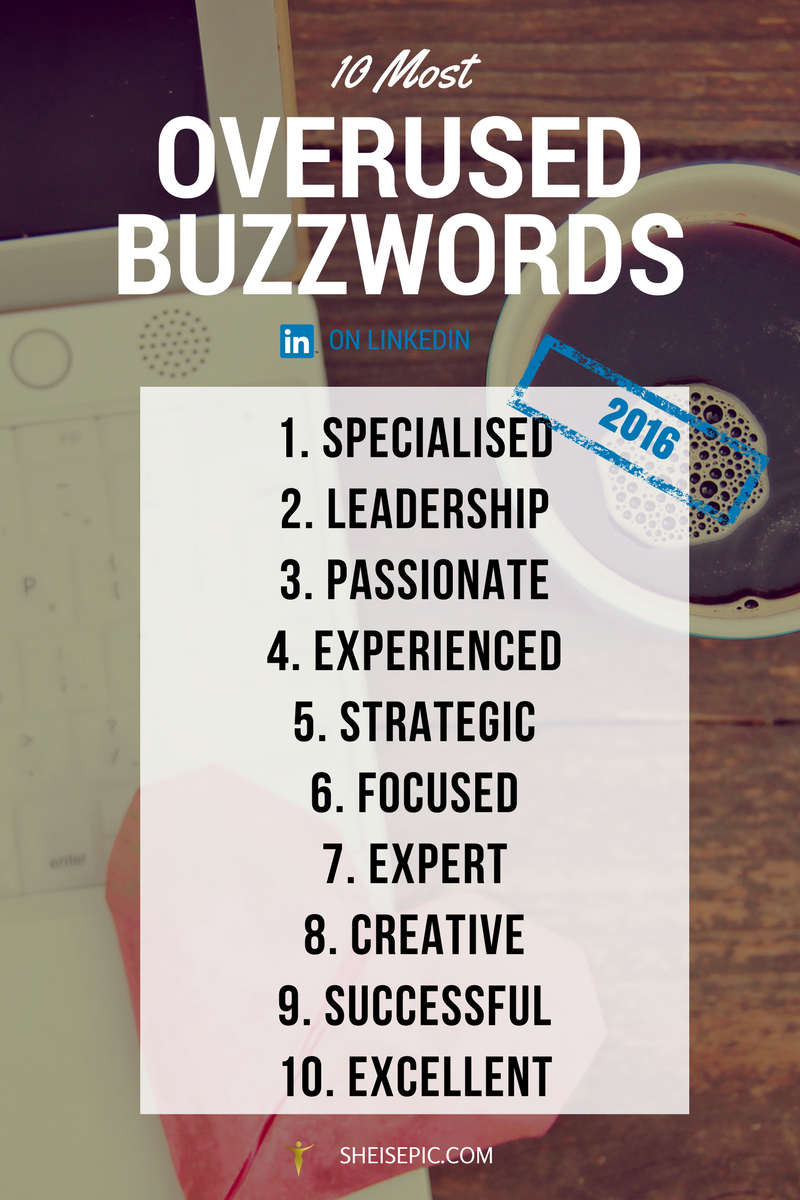
Time to switch it up!
In this video, I share the 3 big ones and swap them out for smoking hot copy. Listen in and then comment below. What other platforms do you want me to take on?
Are you using the 3 LinkedIn buzzwords named in the video? If so, now you have the advantage.
Also, get my smoking hot copy guide to 35 more buzzwords you need to cut out. CLICK HERE

5 Sneaky Ways To Write Using Your Ideal Client's Words
You must understand what goes on inside your ideal client avatar's mind and write the words that will compel them to raise their hand and say, "YOU GET ME!!" and want to buy.
[ short answer ]
How do you find the words your ideal client uses?
Go where your clients talk about their problems, and take notes. Join the online chats they're in, read the questions people ask big names in your industry, search Quora for their struggles, search Facebook groups for phrases like "I need help" or "stuck," and read long comments on popular blog posts. Then use their exact words in your copy.

Copywriting. Is. An. Art.
It's more than flowery words sounding nice on the page.
You must understand what goes on inside your ideal client brain and write the words that will compel them to raise their hand and say, "YOU GET ME!!" and want to buy.
You need to find out what makes them tick, what they cry about and what they’re not posting about on Instagram (Twitter may reveal it though).

When I initially start working with a client, there is always a re-education of the copywriting phase --before the real work begins (does this happen for you too?). Most have their own expectations of what it should be to do what they’re paying you for —which had them getting dead in the water results to begin with.
Annnd that leads us here...
The preliminary work involved in you nailing your dreamy (pays an invoice in under an hour) client before you write a single sentence on the page.
1. Slide Into A Twitter Chat
Let be known, I love me a Twitter chat.
Not because it only requires 1 hour of my time to build & develop a relationship fairly quickly but it's a GOLD MINE for genuine struggles.
People naturally ask questions and share their plights in this virtual discussion. And because you're building a relationship, fairly quickly --they're likely to be more receptive when you eventually offer a solution. Find a Twitter Chat your ideal client is (most likely) hanging out on here.
Live Example:
@cgirlswhoblog This might help: "How To Land The Guest Post On Large Publications In 3 Painless Steps" #CGWBchathttps://t.co/f8B8KVm88K
— Ms. Cooper ©️ (@TennileCooper) April 28, 2016
*FYI: this post stemmed from a Twitter chat...
2. Snoop A Key Industry Influencer's Timeline
Your audience may be pint size but your detective skills should be enormous.
I'm sure you already follow a big-time, successful online guru with over 10,000 followers or more. Yup, that's the one. Find the social media channel they're active on and observe the questions they’re being asked. Chances are they're not going to get around to answering EVERYONE individually.
While the followers pour their aching hearts out, you take notes and use it in your copy.
In order to connect with your ideal client, you'll need to be relatable and use the language they use.
Best Platforms to Snoop:
Instagram
Facebook Fan page (or group)
Twitter (of course)
LinkedIn (Influencers section, hel-lo!)
3. Slyly Scroll Quora Questions
This is the place people go to get their questions answered. It's also a place where the most desperate seek a response. I've seen people ask "how do I quit my job?" or "how do I make money?".
Here's what you do:
Type in the Quora search field, what your ideal client struggles with...let's use healthy eating as an example. The results that pop up will be pondering thoughts of a person debating against mango ice cream or hummus dip.
"Should I take a multivitamin regularly?", "Is dairy good or bad for you?", "How can I not get bored of eating just healthy food?"
These are real questions your people are asking and your job is to answer them in your copy. We'll call these questions, objections, to whatever it is your selling. They want to know two things: do you know your stuff and if you're the expert that can best help them BE a better version of themselves.
Do this well and your consult call will be more of a get-to-know than an icky pitch.

4. Subtly Search In A Facebook Group
I'm guessing you're looking for clients in Facebook groups, am I right?
Well, here's the thing...they're looking for you too.
Just like Quora, they're looking for an answer to their woes and someone to help cure their pain. What you'll find on Facebook are people sharing stories, praising or ranting about something. This is gooood. Really good. But it's super hard to scroll through all the unrelated squabble to find your gems.
That's why you hack the system and type in the keyword of your ideal client's troubles and view the results. You can choose to answer them in their post or keep collecting intel...
Things to type in the search:
I need help
Looking for a *insert your title*
Stuck...
*keyword of Ideal Client woes*

ideal client avatar
5. Secretly Read Popular Blog Post Comments
Eureka!
This is my favorite go-to for one reason alone.
People sometimes write novels in response to an article. Novels! Gushing about how it made them feel or how they believe something different. Juicy stuff here.
There is more content to work with if you find a good post that evoked an emotion that is. Buzzsumo has helped me find a few good pieces I could pull from.
I'm sure it won't let you down either.

ideal client avatar
That’s all folks, you have just been knighted with a deadly weapon.
Make the most of it or it's useless. Persuasive writing can have extreme power over your reader, use it wisely young Padawan.


3 Rules To Break If Your Bio is Still Waiting to Exhale
[ short answer ]
How do you write a short bio that people actually read?
Break three rules. Don't stop at one bio: you need a one-liner for social profiles, a short byline for guest posts, and a longer About page. Write in first person, not third, so you sound approachable. And skip the full résumé. Show you understand your audience and can solve their problem. Being likeable matters more than credentials.

You know the scene in the movie of Waiting to Exhale, when Angela Bassett sets her ex-husband's car on fire and sashay's towards her million-dollar mansion?
That's how your bio should read, dangerous and fierce.

This is probably the most important document you'll ever write.
Next to a fake doctor's note and a Dear John letter.
All short bio's are not created equal and depending on where you're going to use this baby, determines your cadence and sharing factor.
But for your relevance & quick read...
Narrow down the places that require a mini "about me" then think of this article, as your guideline to writing the battle cry for attracting like minds.
From guest posting, podcast interviews and networking cred.
In order for your short bio to rise from the ashes than be burned by boredom. It will require a little more than credential clout.
It requires likeability.
And to do that, it should always include YOU & your message.
You can't take a pass on this.
These days you need a bio for everrrything, from social media to your website and media releases.
Here's how to go from writing like a robot clone to a real live human in your short bio.

Break Rule #1 > You Only Need An About Me Page
*Clears throat* You need 3 types of About Me's.
Your social media micro one-liners, "Hello, it's me!" --blog byline and "Here's why I have a website and you're here" --long story.
Micro: usually used on social media profiles Short: usually used as your guest posting byline Long: usually used on your website about me page
Social Media Micro One Liners: Think 140 characters small (Twitter bio & chat intro's, Instagram, LinkedIn headline, Facebook profile). Where emoji's are your friend.
Business Coach Helping Women Quit Their Jobs & Travel the World ✈ Location-Independent ✌ Island Girl ☀ Minimalist ☮ Join My FREE Tribe - @happyblackwoman
Masters of Education holder and 2016 savage. Kickboxing, scribbling and yoga are my weapons of choice against idle behavior. - @casi_not_cassie
Author of bestseller DO COOL SH*T, CEO & Co-Founder of THINX. Dreamer. Seeker. - @twinmiki
My Creative Connection is the home for #blkcreatives. Storytelling, community + resources to help us do the (Inner) work by @Melissa_Kimble.
Hello, it's me! Blog Byline: A website visitor drops by your blog for the first time, how do you introduce yourself + how you help?

Here's Why I Have a Website and You're Here --Long Story Page: Regardless of popular belief, your About Me page is not about you.
Not one inch of it.
Not a penny or a nickel.
It's about your uncommon approach to your dreamy clientele's persistent pain. More about this later...
Check Out What She Did:
"I’LL WARN YOU: I’M A WOMAN WHO GOES ALL THE WAY. You might end up liking me, or you might not, but one thing is for sure: You won’t be disappointed when I take your business all the way with me.
I’m what you’d consider a high profile, zero nonsense business model expert who specializes in high voltage profit generation for small businesses who are at the sink or swim, do or die stage.
Why? One reason: Because broke is a dirty word and not having enough clients is unacceptable. There are billions of people around the globe, plenty of them with enough money to give to you. My job is to analyze why they aren’t — and then promptly fix it."...
- @rebeccatdickson

Break Rule #2 > Write in 3rd person
This one is so hard.
And such an easy trap to fall into.
Many platforms require the third person approach BUT this is the best chance you got at standing out.
You know who created this rule, right? Journalist & reporters.
It's their standard tone of voice when reporting events and news. Which I'm guessing, you don't do these things.
Besides the awkwardness of reading someone's bio in third person, there is also a certain sense of detachment you feel. It begs the question if someone else wrote it.
Then you start to wonder are they approachable?
And would they answer my email if I wanted to hire them?

Third person language is the most popular way to write a short bio for guest posting, but it puts most people to sleep or they just gloss over it.
Neither one of those things we want.
So the tone preferred by readers is 1st person because with 1st person, we're having a conversation and with 3rd person, you & Tennile will converse.
See the difference?
*I must confess. If you've been following me for awhile or read any of my published features...you'll see I've used 3rd person before. I'm not proud of this. Just want you to know, that's in the past now.
Break Rule #3 > Include Your Full Professional Background
I know you want to show you're legit and could do what you do with your eyes close.
But here's the thing.
Nobody cares about your credentials IF you've properly articulated two things.
1) You understand your audience 2) You have the antidote to their problems
Let's say you had a massive migraine preventing you from crushing your checklist and I said:
"I know the feeling. It's like a ton of pulsing bricks on your head. Take these 2 pills and I promise before lunch, not only will you conquer those tasks but have a scheduled mani/pedi."
You would take the 2 pills because I get it & have the remedy minus the M.D.
Remember your bio is dynamic and a working document. It's constantly evolving and should reflect the stage your biz is at. How it reads today will be flipped on it's back tomorrow and that's okay!

You don't need a double shot of patience, you need a strategy.
When writing your next short bio consider breaking the rules and find your zone, where you can exhale (or wine. Wine will help loosen you up).

17 Lead Magnets That Prove You Don't Need Tricks to Grow Your Email List
Seventeen lead magnet ideas for small businesses, split in two: the ones that earn the email address, and the ones that bring a one-time customer back.
Updated November 2026

Years ago, during Buffer's weekly Twitter chat (do you remember that? Do you remember when X was called Twitter?), they tweeted a chance to win free swag as a thank-you. I gladly obliged, and 3 weeks later I got a handwritten note and branded stickers in the mail.
Who does snail mail anymore? No one.
Quickly. Name one free PDF you downloaded this year. Now name the last business that sent you something after you paid. You remember the one that thanked you, amirite?!
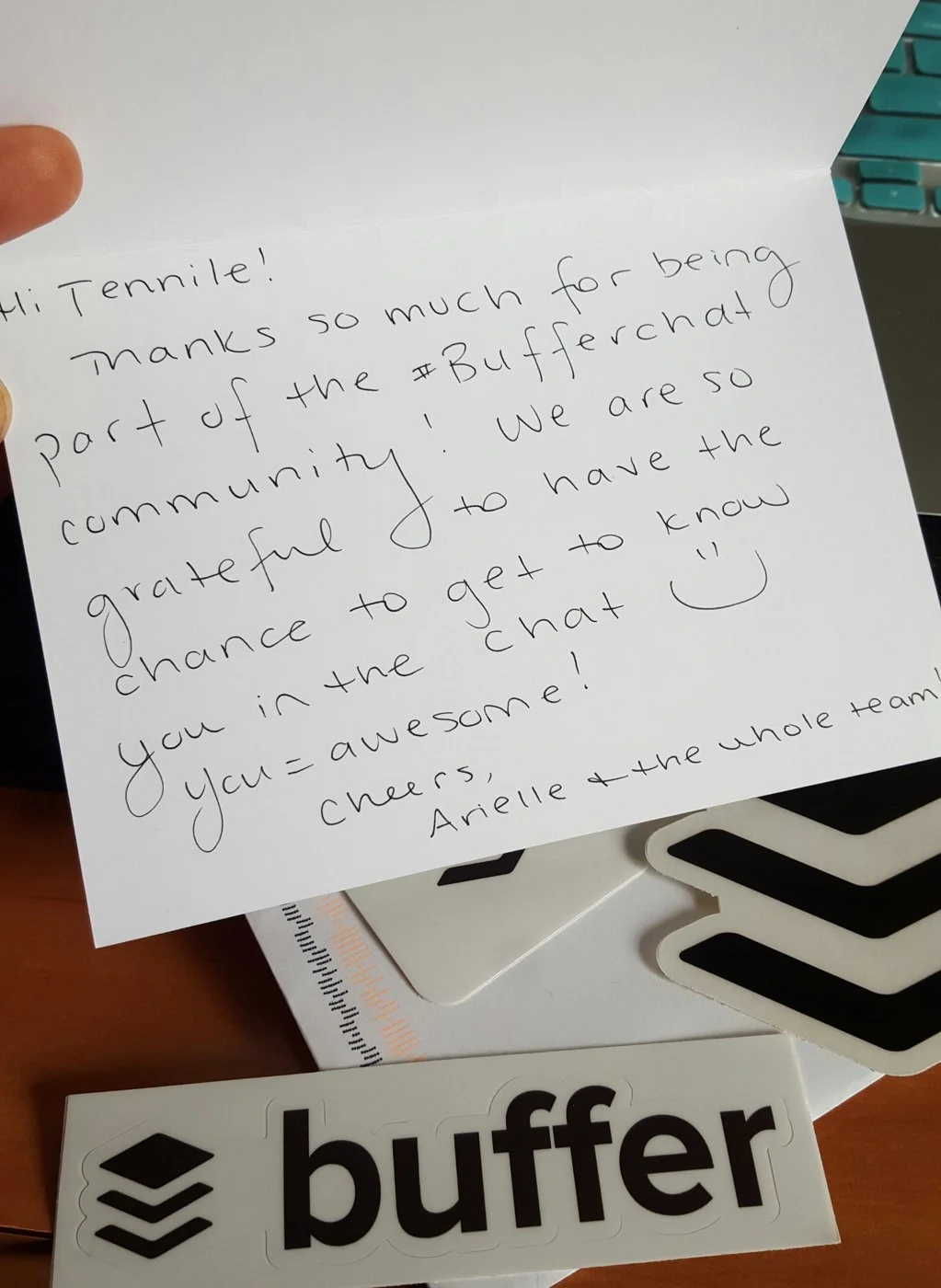
Source: me
There is always some new magic trick on the scene that is supposed to help explode your list-building growth and skyrocket your sales, right? (They even use those exact words too.) From exit pop-ups to a bar that follows you as you scroll the page, and the ongoing debate of a one-click button over forms to fill.
But there is one cold, hard truth that remains. It doesn't matter how sexy you dress up your stuff, or what nip, tuck and stunt you pull to grab eyeballs. Valuable content trumps anything fancy you could ever slip on.
Don't get me wrong. These tactics work… but only when combined with painkiller solutions. The real magic is the unglamorous part: intention, and enough customer research to know which rut your customer would happily trade an email address to get out of.
So here are 17 lead magnet ideas for small businesses that prove the best strategies don't include hocus pocus:
Act 1 earns you the email address and the first sale.
Act 2 earns you the second visit, the repeat order, the regular.
If the term is new: a lead magnet is a small, useful thing you hand over in exchange for permission to land in someone's inbox. A checklist. A quiz. A first-visit offer. Hold on to the word permission. We'll need it later.
How to pick the best lead magnet
Run every idea through three tests before you build it.
It answers a question your customers already ask, in their words. The ones you hear at the counter, in your DMs, in your reviews. If seven people asked it, it's a lead magnet.
It's usable in one sitting. A one-page checklist gets used. A 50-page ebook gets saved to a folder called "Read later".
It points at what you sell. A free colouring page from a plumber is adorable. It books zero drain cleanings.
Act 1: lead magnet ideas that win the first sale
1) A checklist or cheat sheet
One of the easiest lead magnets to create, but you have to make it worthwhile for them to give up the email address. What do you explain so often, you could write the manuscript? Put it on one page: what to bring, what to ask, what to check before they buy. It saves them the overwhelm and saves you from repeating yourself. Best for: any business whose new customers make the same mistake before they find you.
2) A short email course
What have you learned that you can teach? You have 3 clever options: video, audio or email. Drip it out over a week or hand it over all at once. Psst. Word on the street is busy entrepreneurs like it all at once, and when it's a threesome. Best for: businesses where people need to understand the craft before they trust the price.
3) An email challenge
Speaking of challenges… people love a good challenge. What can you teach that's actionable in 3, 5 or 7 days, tops? One small task a day, sent by email. Best for: anything people get better at with practice.
4) A quiz
These are fun. As a kid, I was OBSESSED with getting to know more about me. Who isn't a little narcissistic?? A handful of questions, with the result sent by email. Use a quiz tool that connects to your email platform, so every result lands on a list you own. Best for: businesses with several services or products, where "which one is right for me?" is the question you answer most.
Here's mine: 50 First Bookings, a five-question pulse check on where repeat visits slip away, built with Claude design and connected to Kit. Answer five questions, and you get the dollar figure sitting in your client list, your stuck point and one thing to try this week. The full plan comes by email, and the sign-up box asks before it adds anyone to the newsletter. (Permission, remember?)
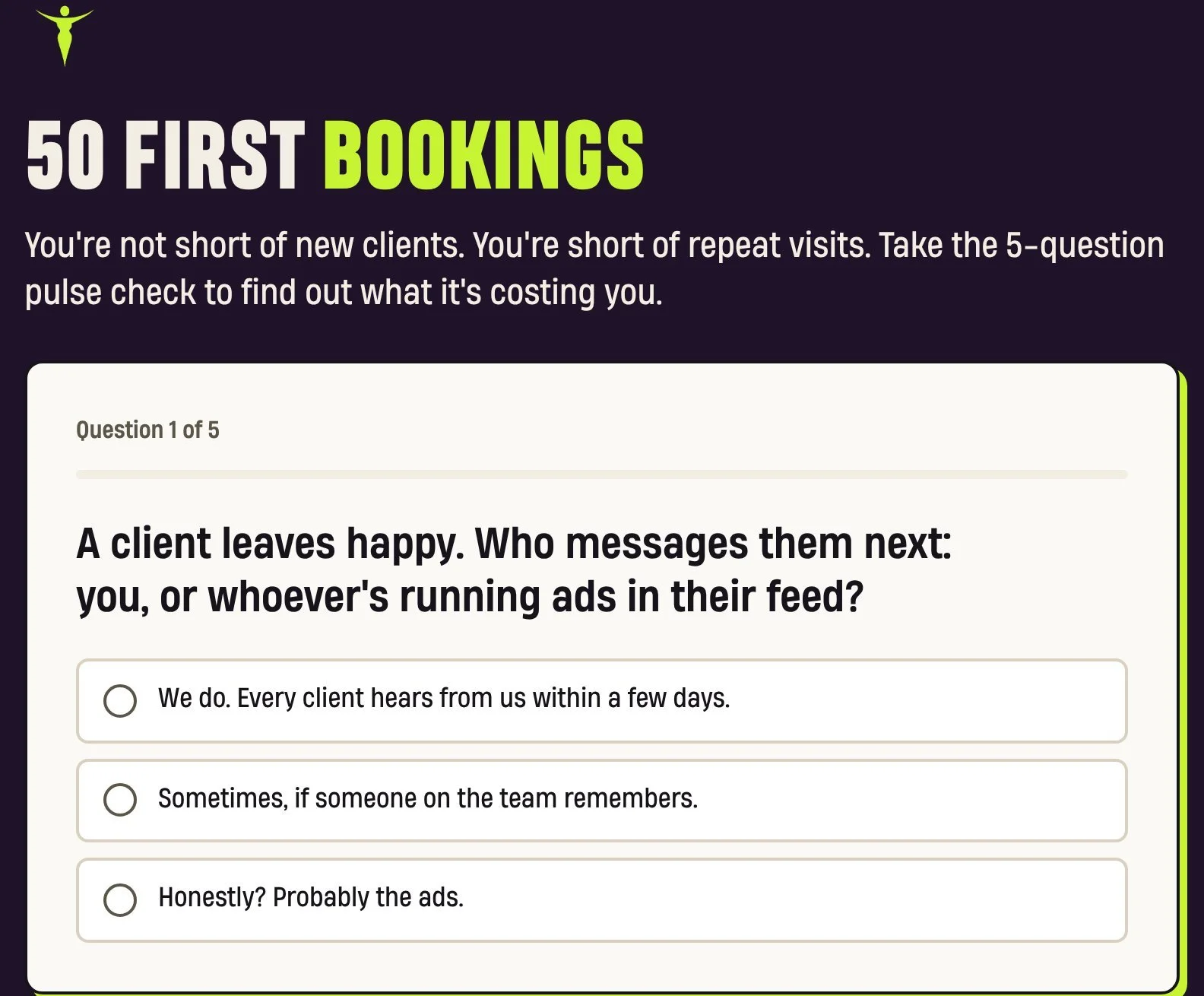
Source: She is Epic quiz
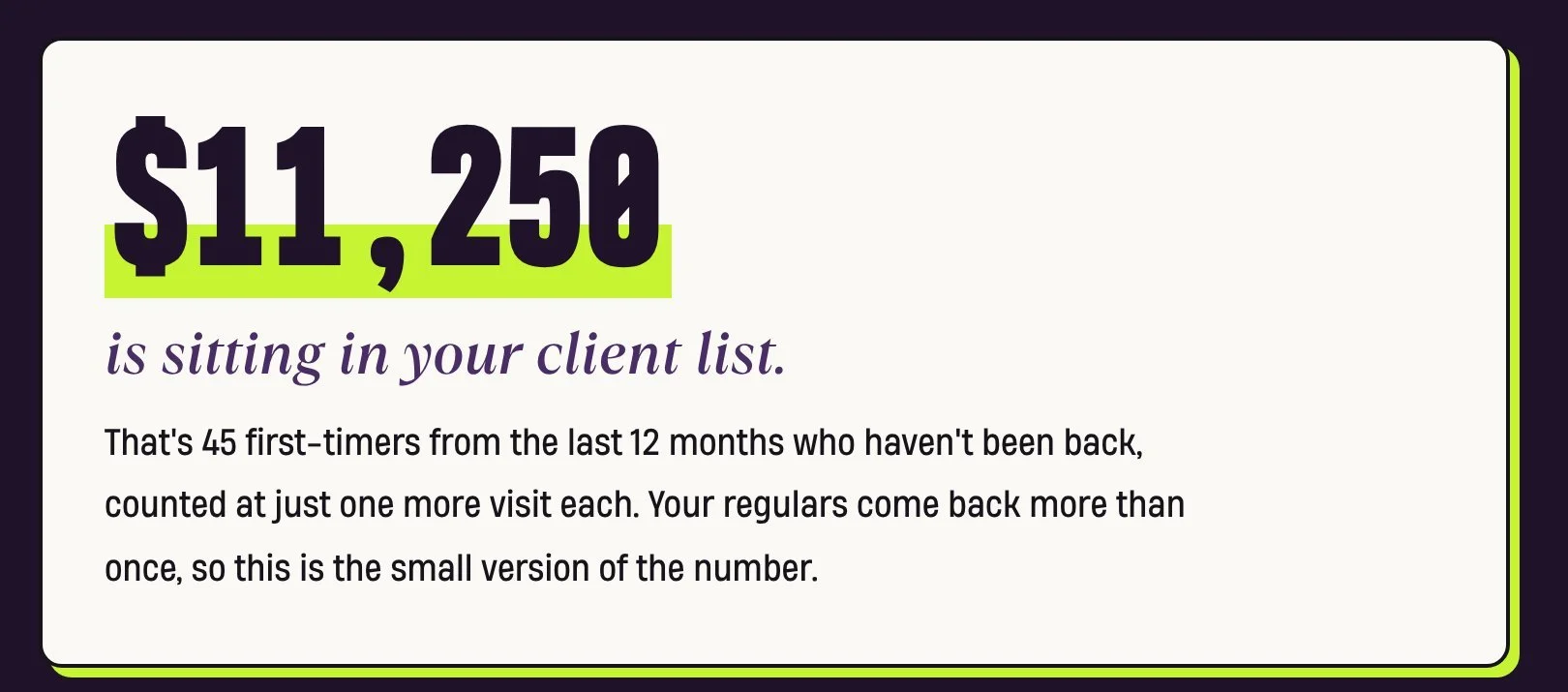
results page
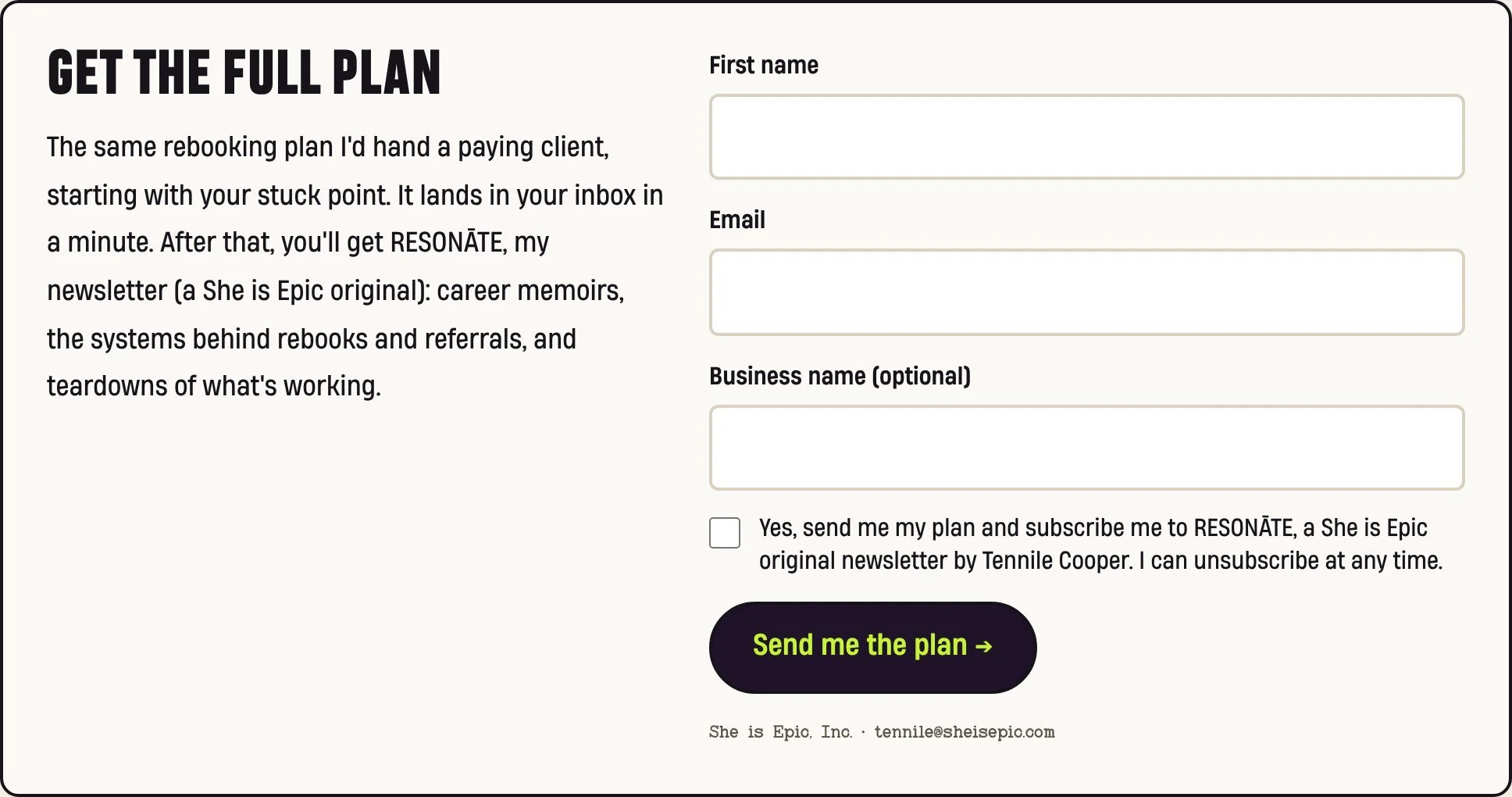
email capture to get the full plan
5) A free quote, estimate, consultation or trial
A number on paper, or a 15-to-30-minute call. Not to give free advice, but to get an opportunity to talk with a live person and see if it's a match made in online heaven. Best for: service businesses where every job is a little different.
Software does the same thing with a free trial. BDOW! (formerly Sumo, now owned by Showit) leads with "Start your free trial" and backs it with a 14-day money-back guarantee, so saying yes feels like no risk at all.
Source: BDOW!
6) A calculator or cost estimator
"How much will this cost me?", answered before they pick up the phone. Best for: businesses whose prices change with size, frequency or scope.
7) A first-timer's guide
What happens on the first visit or the first order: what to bring, how long it takes, what it costs. Best for: businesses whose new customers feel nervous before they walk in.
8) A first-order discount
Coupons can be instant winners: 10% off or free shipping… you get the idea. Highway Robery, a small-batch robe maker in Austin, put a 10%-off offer in a sign-up pop-up and started getting "3, 4, 5 new email addresses a day". Word of caution: discounts can attract deal-seekers who disappear once they redeem. So a Black Friday sale may sound tempting but it trains your audience to wait for the discount. Best for: product businesses with a best-seller people buy again.
Eight Saints makes the new-customer offer feel like a gift: 25% off plus a free Deluxe Discovery Kit and eye gel, a "$119 value" that ships free.
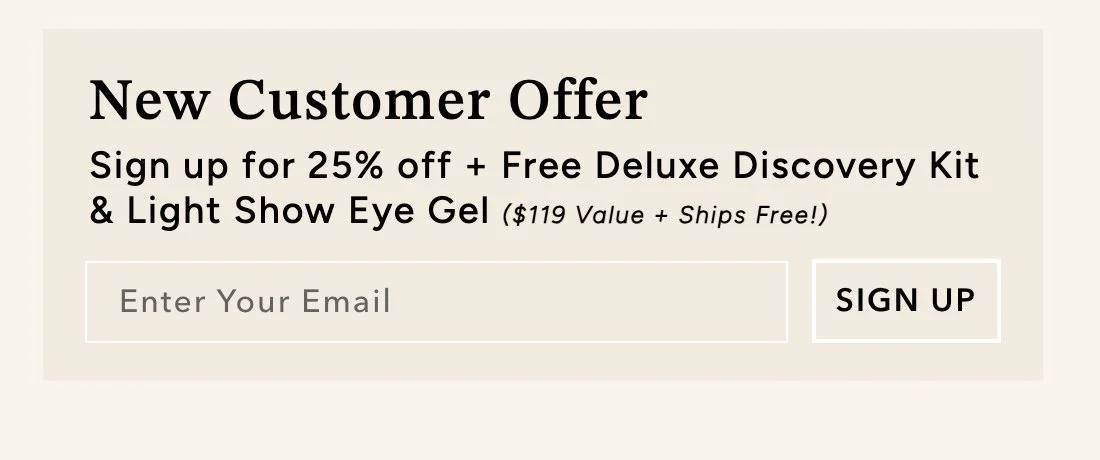
Source: Eight Saints
9) A resource list
The tools, suppliers or apps you'd recommend to a friend. Help your community thrive. They'll thank you for it later. Kinda like this list. (Psst. It's getting a glow-up: a fresh swipe file of lead magnets worth stealing is in the works too. Bookmark this post and check back.) Best for: businesses whose customers keep asking "what do you use?"

10) A short guide or report
Eek! It's not as out of reach as it seems. You may already have one in your arsenal: stitch your last few blog posts, or the questions you answer every week, into a short guide. It's a matter of putting it together in an easier, digestible form. Best for: businesses that know the answers their customers keep googling.
What should you do after someone downloads your lead magnet?
Henry's House of Coffee, a coffee roaster Mailchimp profiled, built the welcome, follow-up and re-engagement emails. It reports its customer retention went from the low teens to an average of 28%. It's an older example, and the system still holds.
Automation scales what you've already mapped out. So map the comeback before you subscribe to another tool.
The freebie earns the address. The follow-up earns the regular.
Act 2: lead magnets that bring customers back
These are for people who already paid you once. Each one hands them a reason to come back. Send only to people who opted in, or who bought from you in the last two years. And every message should name your business and carry an unsubscribe link.
11) A rebooking reminder
For appointment businesses: a message timed to when they're due again. Booking tools like Fresha have a "reminder to rebook" built in. Check yours. It may already be sitting there, switched off.
12) A "your next order" email
For product businesses: ask how the last one went, then shrink reordering to one click. Henry's follow-up emails ask customers to rate and reorder, and its 14-email product follow-up series has made $1,539.
13) A "when to come back" calendar
The classic calendar lead magnet, aimed at the customers you already have: when to reorder, re-service or rebook. Printable, or a calendar invite they can save. Make it one of those eyegasms they tape up on the office wall (or admire on the refrigerator).

lead magnet ideas
14) Customer-only perks
Cheese Grotto sends members monthly emails with exclusive discounts and early access through the email provider's best-customers automation. The members-only club is the one they've already paid to join. Give your regulars a peek behind the great OZ curtain.
Eight Saints runs an exclusive Facebook group where customers see before-and-after photos, ask other customers questions and get new products and sales before anyone else. That's the one kind of Facebook group that earns a spot here: it's for people who already bought.
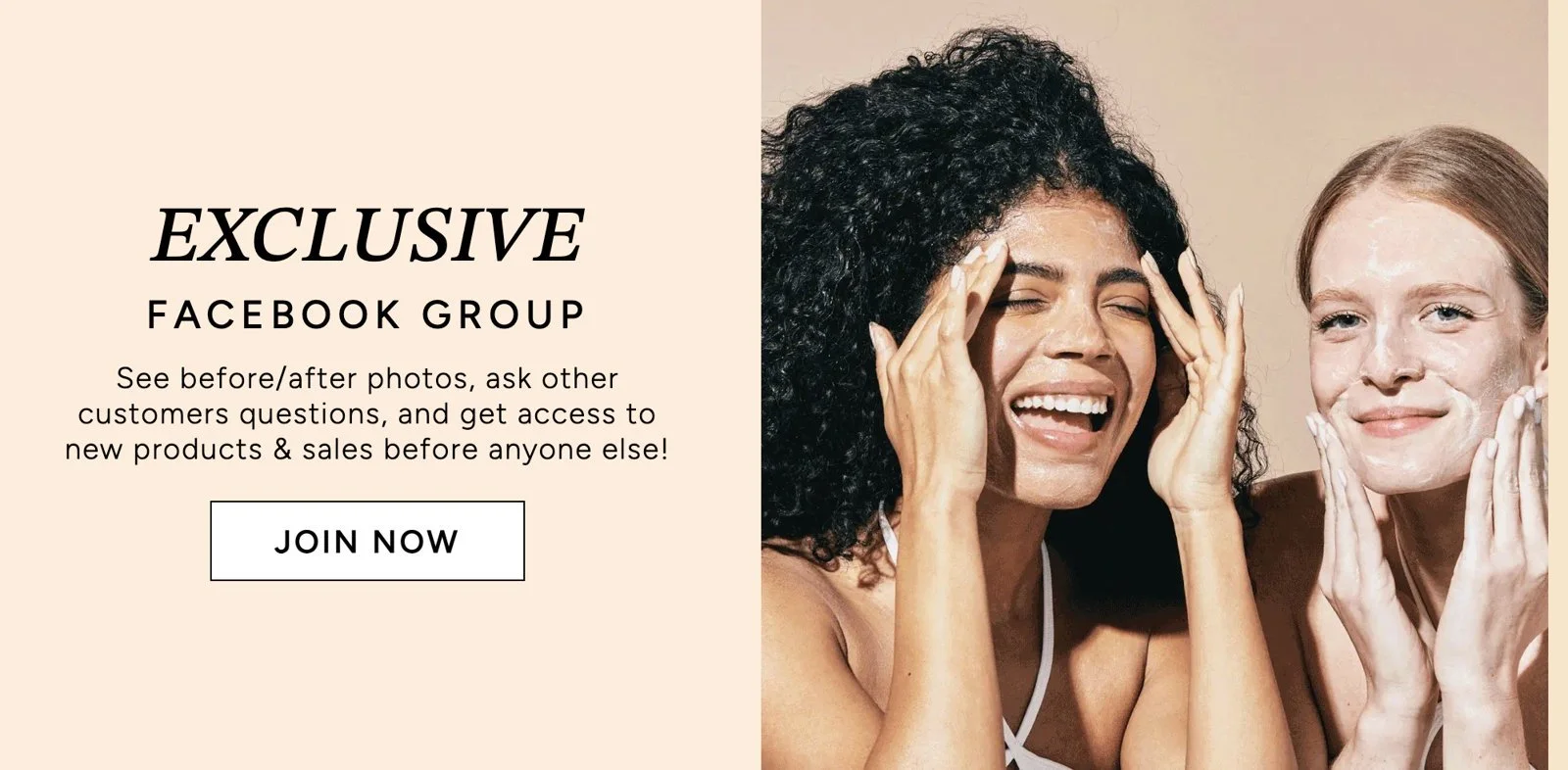
Source: Eight Saints
15) A win-back offer
For the customer who went quiet. Henry's separate two-email re-engagement series, sent to customers who hadn't bought in a while, made $1,466 in seven months. Two emails.
16) A thank-you in the mail
Back to Buffer. For years, Buffer sent handwritten cards, usually with stickers, 40 to 60 packages a week, with stickers costing 28 to 56 cents each. The chat I joined retired in 2018. The lesson didn't. A handwritten note after a first purchase costs a stamp and a pen. Now, that's how you cut through the noise.

Source: Buffer on Twitter (X)
17) A birthday or milestone message
A note on their birthday, or on the anniversary of their first visit. Fresha builds this one in too.
BONUS A pledge
This is totally left field, and I love it! Get your readers involved and have them take a pledge. Ash Ambirge of The Middle Finger Project had readers sign their first name and email to a vow, then hit "Pledge vow."
It works for any business that asks people to commit. A Pilates studio could have new clients pledge to the future version of themselves (revenge body and all). It makes it real, because it's a pledge to yourself. And the email address is the signature.
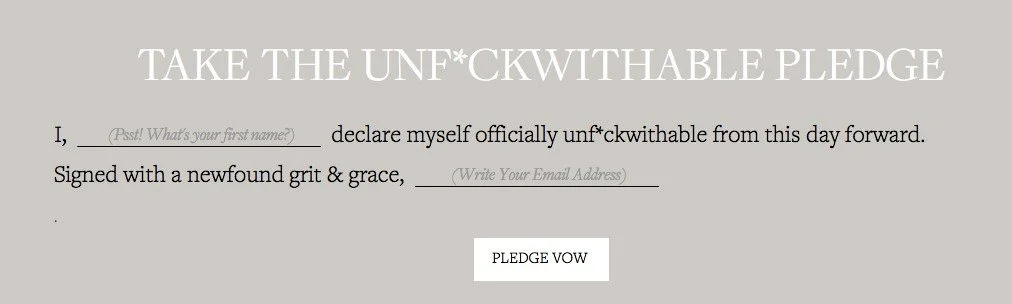
Source: Ash Ambirge
Do this this week
List every customer who bought or visited once and never came back. Pick one Act 2 idea and build one comeback message: a rebooking reminder or a "your next order" email. Send it only to people you have consent for. Under Canada's anti-spam law (CASL), a purchase in the last two years counts as implied consent; everyone else needs to have opted in.
A handwritten note. A rebooking reminder. Two emails to the customer who went quiet. Nobody remembers the PDF.
[ the master plan ]
What lead magnet ideas work for a small business?
The ones that answer a question customers ask, take one sitting and point at what you sell: a checklist, a quiz, a free quote. Then build the second act most lists skip: a rebooking reminder, a "your next order" email or a win-back offer, sent only to people who agreed to hear from you. Henry's House of Coffee reported retention climbing from the low teens to 28% after adding follow-ups.

4 Platforms to Leverage, When You're Time Poor & Want to Make an Impact (Tout Suite)
If you've been at this for awhile, then I'm sure you have been told posting in Facebook groups is a surefire way to get clients?
Or, if you're not posting 3 times a day (on social media) ---nobody will know you exist?
AND...you're not about to pay to play using Facebook ads (more about this another time).

Get The Audio Sysnopsis or Read On:
Finding the best platform to sell online is like digging for gold without a shovel.
Your hands get filthy and you tire yourself out before uncovering the nuggets.
If you've been at this for awhile, then I'm sure you have been told posting in Facebook groups is a surefire way to get clients?
Or, if you're not posting 3 times a day (on social media) ---nobody will know you exist?
AND...you're not about to pay to play using Facebook ads (more about this another time).
That's one way to go about it...
But I grew weary of it quick!

If you're anything like Naomi me...a social introvert that has a packed schedule of --LIFE. And only want to speak on the things that add value, not waste time.
Here are 4 platforms (other than Facebook) to leverage, when you're time poor and want to make an impact --tout suite (that's french for fast).
Brushing up on a 2nd language I've never used before this.
1. Twitter
This has become my new playground.
For a couple of reasons. [1] Lead Cards:(Jen Lehner has a great graphic on this). It's a way to capture your followers email...for FREE, in one click. Use it, just as you would a regular tweet. [2] Twitter Chats: participating once a week for an hour, can really boost connections quickly and most importantly authentically.
A Few of My Favorite Chats:
@soasidehustler #SideHustleChat Every Tuesday @ 8pm est.
@2MovesAhead #HERmovementEvery Tuesday @ 9pm est.
@Buffer #BufferChat Every Wednesday @ 12pm est.
@_MYCC #blkcreatives Every 2nd Monday of the month @ 9pm est.
@ChelseaKrost #MillenialTalk Every Tuesday @ 8pm est.
@BizGalz #BizGalz Every Monday @ 1pm est.
@melcoach #SpeakerChat Every Tuesday @ 7pm est.
@BrandChat #BrandChat Every Wednesday 11am est.
@KateNasser #PeoplesSkills Every Sunday @ 10am est.
@natejturner #BeIntentional Every Sunday @ 9pm est.
Introduce yourself in new chats using this format:
Hi, new to #twitterchatname! I [what you do] @ [name of biz] for [target audience] to [how you help].

(try to stay within 140 characters)
2. Instagram

I haven't quite mastered Instagram and I don't really know if it's the best platform for a service-based business. But as a product-based business, you should invest some of your sweet precious time here. Research & use hashtags in your industry, post at least once a day and get featured on an account with higher followers than yours. This will get you in front of your audience quick.
If you're not the best at writing lengthy blog posts, treat Instagram as a blogging platform to share your story on the go. Here's a picture guide of a super easy way to write your Insta bio + captivating captions.
And here's a great resource that slay's the game of growing your Instagram followers.
3. LinkedIn

This is the best space for B2B marketing (Business to Business). Decision makers mostly hang out here and if you've gained 500+ in connections, I certainly hope you have claimed your authorship rights. With every newly published post, your connections get notified and you stay on their radar. If you're still growing your LinkedIn following, this could help.
Be sure to have a call-to-action at the end of each post (what your readers should do next).
4. Email
This actually should be #1 but for emphasis, I saved it for last.
Email is by far the best space to leverage. You can speak directly to those who have taken an interest in your business. No frills, no fanciness and no hashtag lurkers in your convo.
- Reach out to people/businesses you'd love to work with...
- Extend your services to previous clients & see how you can help...
- Keep your email list in the loop of what you're working on...
Most often, it only takes one well-crafted email to make an impact.
