

How to Build a Career—Not Land a Job, My HDSB Interview
In the midst of COVID-19 (May 2020), I chatted with the Halton District School Board. They reached out for me to share my communications and marketing career journey. The first ten years of my professional life was in a job instead of a career, had I received this insight at high school, I would already have the awards and wealth that match my work ethic.
[ short answer ]
How do you build a career instead of just landing a job?
A career is built around impact, mission and passion, not one employer. Look for internships and mentors early, learn the basics of your field, develop one or two specialties and combine them creatively, stay close to your peers, and keep outside interests that feed your work. Bringing your own way of doing things to the table is what turns a job into a career.

Watch the video at the end of this post.
In the midst of COVID-19 (May 2020), I chatted with Lisa Galay, the Leader of Experiential Learning for Grades 7-12, for the Halton District School Board.
They reached out for me to share my communication and marketing career journey, as well as the subjects that students study in high school that relate to the work that I do on a day to day, including business, english and creative subjects such as the arts. The first ten years of my professional life was in a job instead of a career, had I received this insight at high school, I would already have the awards and wealth that match my work ethic.
This is how I am building my career. Which it’s not tied to an organization, business or job—it's when the impact, the mission and the passion are at the forefront. Thank you to Karamjit, my long time mentor and friend, for this connection.
Here goes my interview with HDSB.
Lisa: We'll start with our first question, which is—what was the educational journey that you took to get to your current career?
Tennile:
Well it was definitely not linear.
I zigzagged all over the place. However, I did start in the social service worker program at George Brown college. And went on to spend 10 years in that field. Shortly after, I pivoted into I.T. because I had a natural ability in computers and wanted a change in my career, but I wasn't sure what it was. I went with what came natural to me. And then pivoted again into communications by starting a copywriting business.
After five years of running my copywriting business, I sought out formal education in marketing and sales. The later part of my education was tied to more experiential learning, which you're very familiar with, being able to connect to people in the industry. That's what helped me to navigate my career journey.
Lisa: Excellent. Can you share a little bit more about your current career and the day to day responsibilities that are involved?
Tennile:
Yeah. So have a full time job. And I also have a side hustle as like, as they like to put it.
At my full time job, I manage the marketing of six event venues at Artscape. In my day to day role, I lead the marketing strategy, planning and execution of it, producing and analyzing Salesforce data reports, the results of my marketing efforts, the advertising and social media campaigns that I put forth to increase revenue targets year to year. And I also develop marketing copy (i.e. communications and messaging) that resonates with Artscape’s target audience, mainly to maximize income generation and gain sponsorship opportunities.

On the flip side, at my side hustle, I run a copywriting business that helps businesses revive their marketing and messaging efforts. In regards to marketing material, website copy and social media. I truly credit my own business for launching my career into communications and marketing. It gave me access to a network, credibility, and leverage, and that has been built through studying and working on my craft—without hesitation of being able to put it forth into the world. It has allowed me to create a fund that helps underestimated women led businesses to scale in their own venture.
So it's that experiential learning again, where it's me being in the field, doing the work and then seeking the knowledge afterwards to round it out, basically.
The challenges & benefits to a career in Marketing & Communications
Lisa: Excellent. It sounds like that's a busy life you're leading there. So I don't know. What would you say are both the challenges and the benefits of your current career?
Tennile:
Oh, okay. Challenges. So I recently had this experience, like I said earlier, I was in my own business for five years, and then I decided to return to the workforce. When you’re applying for a job in communication and marketing, you are put through a series of assignments. Your aptitude is tested over other careers, meaning that they set up assignments for you to showcase your marketing skills, your communication skills, and then you have to submit it back. And so you feel like you're giving your skills and your ideas away before you actually have the job. And it can be emotionally taxing, especially when I was applying to at least twenty jobs a month and I was averaging about a one to two interviews a month.
And so, that was a lot for me to always have to do an assignment then go in to talk about my skills, versus another career where you don't have to jump through all those hoops. That was a challenge!
To add to that, the marketing community is regularly evolving. Nothing ever remains the same. Therefore, the role in communication and marketing requires you to stay current and well-read, and continuously sharpening your skills in writing and staying creative.
Now, for the benefits, because this industry is always evolving, there is room to grow within it. I mean, as long as you're evolving your skills as well, it's not something that can be automated by computers. Although, they certainly will try to automate it, but it still requires a human touch. It requires a human to relay the emotion through storytelling and being creative—computers can not do that.
That is our superpower.
Nothing can be put out into the world without a good writer and a good angle for it to become valuable to the market.
So that's where communication and marketing comes into play. And then in terms of compensation, it's a nice perk because you're paid more due to the demand of this specialty. Under the umbrella of communication and marketing, there are several different roles that you can do. It isn't just Marcomms, which is the short form for communication & marketing. You can hop into any industry, so it isn't just set in healthcare, you can be in tech. You can be in I dunno, environmental science, like every business needs communication & marketing, there's no barrier.
Lisa: Right! Excellent. Well, that's a really nice segue to our next question, which is where do you see this career area going in the future? Both in Ontario and beyond, it sounds like it's going to be promising.
Tennile:
I think so, that's one of the reasons why I pivoted from working in social services, into communications and marketing. I felt like there was more opportunities, way more ways you can hop from one thing to the next thing, still being under the umbrella of communication and marketing.
I think we're moving into a digital data age where our phones, computers and Alexa knows more about us than our family.
They're collecting this data for a reason, you know, to sell to us better and to shorten the sales cycle with personalized messaging and marketing.
So when you see an ad that speaks to your exact need, that is marketing, when the ad captures your exact feelings, that's communications. It's not going anywhere. We're going to be constantly be sold to and therefore we need the experts in place to help companies do that. And more and more brands are trying to find ways to humanize their brand because a corporate logo can't do that.
Less promotion and persuasion and more focused on the customer experience and the culture of the company. Where I see the direction in terms of where marketing & communication is going, it’s definitely influencer marketing. Which means, we see those experts on YouTube and Instagram that have a high following and high engagement. Those are influencers because they are regular people sharing things that they enjoy. And like and in terms of content marketing it's just a consistent way of informing, entertaining and engaging people throughout the whole sales cycle.
And so consumers are starting to trust those forms of marketing over a traditional ad that you'll see, like a commercial. They are more likely to trust another person. It takes great marketers and communicators to foster and sustain that trust. Like I was saying earlier, in terms of communication and marketing, it’s under the umbrella to all these other things that you can do—it isn't just Marcomms. You can get into video, audio production.
Although we'd like to focus on business and English, people who are in the arts, there is an opportunity to get into communication and marketing as well because creativity is needed in these roles. And so video/audio production, interactive technology like AI (artificial intelligence), and managing mobile marketing is how we're shifting marketing. It’s shifting away from commercials and going to mobile—your phone, because what companies are clamoring for is the attention of consumers.
Social media can be so overwhelming and inundated with everyone trying to sell to every and anybody, they had to find another way to reach people. And now it's through text messaging because how likely are you to check your text message over your social media notification? You're more likely to check your text message because you think it's from someone, you know, personally, right? So they're now moving towards that.
SEO, like search engine optimization is a role within itself, as well as search engine marketing, SEM marketing through Google ads. You see those ads that follow you around everywhere online, that’s search engine marketing. They're annoying, but it works! Social media, e-commerce, email marketing, marketing automation, content management and curation (the publications that need someone to write articles for them and distribute it), web development, design, copywriting, and editing (the realm that I'm in), analytics, you need people who can read the data and transcribe the data, can explain the data in lay-mans terms—that is so needed. And the business and marketing strategy aspect as well.
So in 2020, in our current year, mobile marketing, marketing automation and social media are at the top of the list in terms of demand and importance of these skills for now and in the future.
Lisa: Wow. That's a lot to wrap your head around, but fantastic to know, so many opportunities. Again, you touched on this a little bit already Tennile, but when we think back to high school and the subjects that our students are studying, you've made some connections already to your work in terms of english and business communications technology, the creative subjects, such as the arts. Maybe you can just share a little bit more about how you see those different subject areas working their way into the responsibilities that you have day to day.
Tennile:
Okay, with every career or venture you take on, you must learn the fundamentals of it in order to thrive.
Must, must, must, must. I believe school provides that for us and that's why till this day, I take courses and keep my knowledge sharp in my field. I still take courses. I still go to school and take online courses and whatnot. When it comes to business, you must know how to write a business plan. Even if you never need or use it, you must know how to do it. When it comes to marketing, you must know the principles of market research, even if the company that hired you based their marketing decisions on making the CEO happy. Which I've been in organizations where it wasn't about the research, it was about making the CEO happy. Even if that's the case, still know the fundamentals of it. And then when it comes to english, you must know how to effectively communicate and tell a compelling story.
It's the basis of connection. That is what will make you valuable within any company. Being able to communicate to people on a people level and not on a corporate level. But what is most important of all is being able to utilize all three; the skills and talents and education that you have is being able to utilize them all in a creative manner that produces results, streamline processes, or even tell a better story than the existing one that the company has. And that's why I'm also emphasizing the arts being important because you cannot automate or computerize creativity. Humans only can do that.
It's important that we continue to be critical thinkers and be creative in any work that we take on.
The impact of covid-19 on marketing & communications
Lisa: Excellent. Thank you. Switching gears a little bit. Can you tell us about what the impact of the COVID-19 pandemic has been on your career?
Tennile:
COVID. Ahhh. So COVID-19, didn't really affect me in my career, although in my full time job, I work in events. So it affected that aspect of it but in terms of communications and marketing I saw more business in my side hustle.
Also, communication and marketing people are more needed in this time. It is required for more messaging, accurate messaging, comforting messaging, and an angle that helps minimize potential panic in a crisis. Communication and marketing are needed even more so during this time, people are looking to companies to see where they place their importance. Do they care about their customers or only their bottom line? What charities do they support? What's their mission, their values? That comes up more clearly in these types of situations, and people, consumers are paying attention to what companies are doing during this time.
That's why a plugged-in Marcomms person can read the room or gauge the temperature and produce content matching the wants of their audience or the needs of the audience. Like I said, I had increased communication work during the pandemic than the reverse because of this skill, because I was able to read the temperature of what people are looking at, viewing, and knowing that we have to shift from selling and shift to engaging people. More in terms of, you know, what's happening in the world right now, let's speak to that. How are we helping in the community? For example in the events industry (at my full-time job), we shifted from selling our venues because obviously there's no events that could happen, to helping our partner vendors like restaurants who have had to close down or pivot their business to doing takeout.
We then promoted those restaurants so that they can get the business instead of us getting the business because that is our partnership. When we are back to “normal”, we want to ensure that they're thriving, whether we're open or not. So if we're not selling, we're going to be selling our partners food so that they can get the business. Right. So that's an example of how Marcomms can kind of just shift the conversation to less selling, more engaging with their audience.
Companies need language that maintains or increases the credibility or public standing during critical periods like this.
my advice for a career in marketing & communications
Lisa: All right. So interesting. Thank you. Tennile for students that might be thinking about going into a career in, in marketing and communications is there any particular advice that you would give them to help support their pathway there?
Tennile:
Yeah, definitely.
I'll tell them the pathway I took was by seeking internships and mentorships. I've had a lot of great mentors in my life and still to this day—as a grown adult—you know, full career and side hustle I still seek out mentors. There are definitely areas that you're going to still need to work on. And mentorship is a mutual thing. It isn't take, take, take. It's more like, yes, I'm seeking your expertise in this area because you're further along in your career but I also can help in the areas that you may not be aware of too. It's the old school helping the new school type type of deal. So definitely, I would start there before you even decide on a career path, internships and mentorships.
Once you've decided, learn the fundamentals, soak up the knowledge in whatever work room you you're in. Pay attention to what's happening at you're internship and in the job that you've taken on. Be a sponge when you're there, gain a specialty in one to two areas because you need to be able to take those specialties and be creative in how you mesh the two. Make them work together well and make connections in your industry.
That includes your peers, the peers that are sitting the left to you and the right to you. You never know where each one of your peers are gonna end up in the world or along their career journey. You know, keep those relationships alive. Don't always reach for people who are 10 steps ahead of you, always keep people who are on the same playing field as you—those who are one step higher, one step lower by your side as well. You never know who you'll learn something from cause you'll need that network to do your job better than the average person in your field.
And then on top of that, I would say having outside interests, it fuels your full time career. My outside interests is my side hustle, it really helps to elevate my full time job. There are certain skills that I've learned outside of my job that I'm able to bring into my role that makes me more valuable to the company. And it also decreases burnout. You don't want to always be focused on this one thing and then everything else kind of falls to the wayside. So, have your outside hobbies, it doesn't have to be something that makes you money. It could also be something that just brings you joy. Right.
Learn to bring your own way of doing things to the table.
Add your extra sauce or magic to your work. That's what makes it a career and not just a job. Yeah. I'd say that.
Lisa: Yeah. That's great. Thank you. Wonderful advice for our students. And my last question Tennile is, again, going back to those subject areas that connect to the work you do, business and english and the creative subjects and communications technology, what would be your message to students about the importance of taking a variety of courses like those in order to keep the doors open to future opportunities that they may encounter?
Tennile:
That's a good point. Keeping the door open for future opportunities.
Yeah, the importance lies in continuous thirst for knowledge, period. Business, english, the arts, whatever you want to take you gotta be able to know what to take. You have to determine what specific knowledge you need because it will evolve as we get older.
As things change and technology evolves, no one knew 15 years ago that technology would be at the epic-enter of everything we do. And knowing how to operate a computer would become such a basic skill to have but here we are!
Be open to the evolution and pay attention to, you know, what is needed and how you can market yourself.
Really, and truly, your future success lies in your ability to know what is needed. What does the market need and get creative with your existing skills and knowledge to either execute on it or gain the information you need to execute on it.
Lisa: Excellent. Well, that's a wonderful note to end on. So thank you so much Tennile for sharing your career journey and your wisdom with our students today. We really appreciate it and we hope you have a great day.
Tennile:
Same to you. Thank you so much for this opportunity.

You're Not Tired —You're Uninspired, Dead Inside and Waiting For a Sign (THIS IS IT)
What do you do with the bellyaching haunting of your calling?

That’s me! Practicing before my website photoshoot 2 years ago. Finally, taking this running a business thing seriously. Even if at one point —it was all a dream.
The days of being on someone else’s clock and a part of one giant corporate cog can leave you feeling empty.
Then you mistake the nudges, signals and omens appearing right before your eyes to try something different this time.
You write it off as a coincidence.
Or play it down, as your mind playing tricks.
On the contrary, the haunting of a calling that requires you to step up —makes itself completely obvious. It’s the 20-years committed relationship advice of how to choose the ‘one’ —“When you know, you know” cheesy cliche. It’s the thing you can’t outrun.
And I’m sure, you know this already.
You can feel it in your gut —it’s time to show up and put yourself out there. Go ‘head make a spectacle of yourself! Unabashedly, ignore the naysayers of high school past and JUMP.
Yet, no dice.
The exhaustion of it all, leaves you feeling too drained with no remedy or words to explain. You want to show up but it may just take everything in you (and heaven forbid it be in vain). You just know, you’re tired of showing up for everyone else. Despite the inner conflict, there are still comforts you’re not willing to give up. So you swaddle yourself in every reason to ignore the true demands of this haunting calling.
That not even a Doctor has the answers to spike your energy levels. It’s not your sugar intake or the absence of iron supply. Although it’s all connected somehow. Nor trying a new workout routine to provide the needed jolt for more of a happy endorphins cure. But just like Black Friday, the rush doesn’t last and neither does the allure.
And you’re right back to where you started, tired and tapped out.
TAG --(this isn't the childhood game where you try not to get caught). I SEE YOU and I'm tagging you back in.
The goals that you’ve put on the top shelf and out of reach from yourself. Climb up on that stool right there and pull it down. Now, look at it as it sits in the palm of your hand. The dream deferred, dusty and neglected. Faded and tarnished —but nothing we can’t polish.
All you need to light a fire is a spark.
To put it plainly, nobody is standing in the way of the bellyaching haunting of your calling.
Just you versus you.
I DOUBLE DOG DARE YOU to prove it wrong (and you can name that “it” anything you want). Either way, “it” is causing a soul-lit-up drought.
A tsunami of blockage.
A catastrophic case of dormant potential.
This isn’t a call-to-action to quit your day job. No, Ma’am. Nor a high-stakes waiting game for conditions to be absolutely right. That’s not what this is about.
THE SIGN IS HERE.
It is a battle-cry to quit doubt.


Motivation, That's Over —it's Canceled (Here's What You Need to Push Progress)
What motivates you? A question we rarely ask ourselves but should. However, not for the reason you may think.

READY OR NOT
Take a chance. Bet on yourself.
The commitment to do well is a lifetime of choices that you make daily. The space to live in is not "I'll try." Not "I want to". It's "I have decided." - Auntie O.
What motivates you?
If you've never asked yourself this question, ask it now. I'll wait....
It's a question, that if we're not careful, we could stumble down an endless emotional motivation pit we constantly need to fill. So we can constantly feel like we're making progress.
Spoiler Alert: you will never feel motivated to do the hard things in life. That’s why only 3 out of 100 people will have washboard abs. So we require just enough motivation to at least like what we see in our reflection. We motivate ourselves to roll out of bed, do household chores, eat our greens, learn a new skill, go to our job, create multiple income streams, click no when Netflix asks if we're still watching. Yet, motivation is not enough to keep us on the path of progress.
What if, motivation was not what we needed?
Instead, what if —it's the effect, not the cause toward improvement? Would it change your mind on how you skim YouTube for your next fix?
Would you stop waiting for motivation to strike like a lightning bolt?
Would you make the decision to take this small action instead? Invent momentum.
You don't find a soulmate by sitting at home. You don't get noticed by grasping to hope. And nobody wants to mentor someone without potential. People and things are usually drawn to people who go for it.
Take a chance and bet on yourself.
Do one thing, then that one thing turns into another thing and that thing turns into SOMETHING. Then before you know it, you're motivated to keep the momentum going.
Action begets action.
You gotta do more than want it, you need to make things happen. A small thing, anything —just enough "I have decided" energy to at least like what you see in your reflection.
Invent momentum.

Labels, Language and Living Out Loud When You Feel Lost
Life paths are not usually straight or narrow.
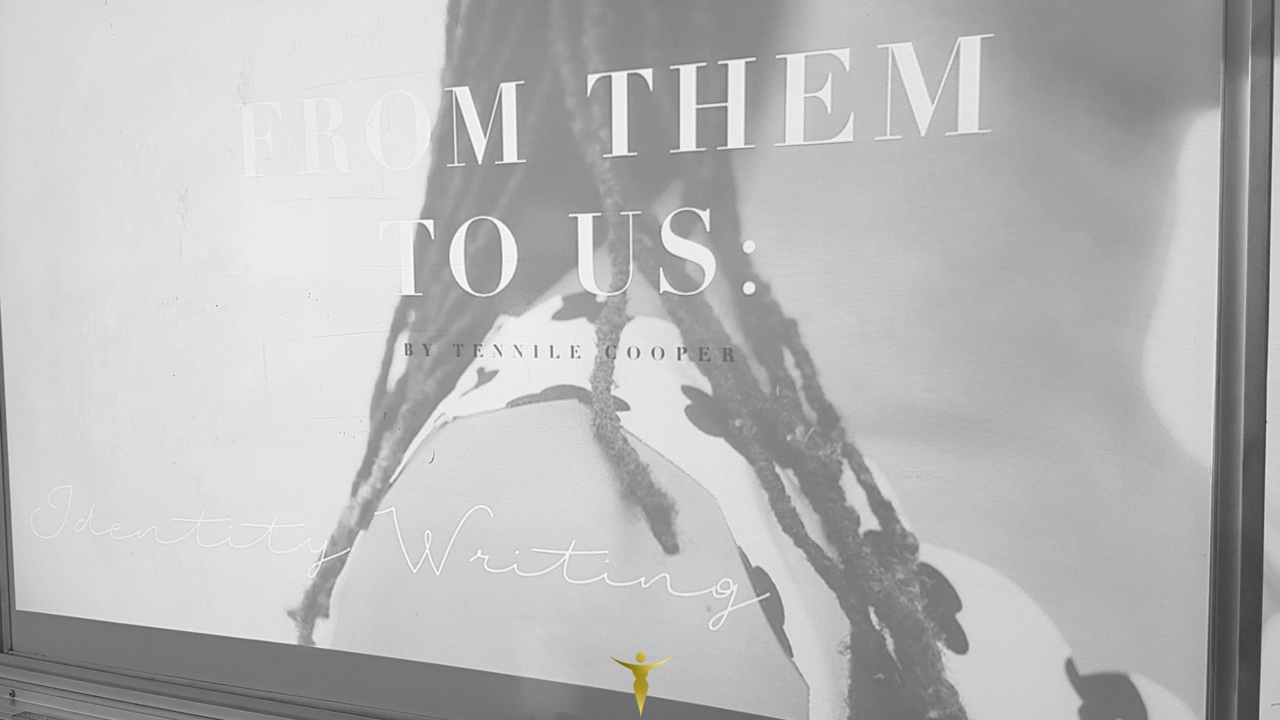
Last week, I ran a workshop to a group of 16-year-olds (more on the topic later).
One, in particular, was fixated on how confused and lost she felt.
"I need to figure out what I want to do. I have to choose before I go to college." She said with panic in her voice. I told her the exact same thing Gary Vaynerchuk once said.
As it's completely normal to feel this way. Especially still so young, "You have time." I reassured her.
Once she tries on, a whack of things, she'll know immediately. It will become easier to decipher what you really want and what you don't need.
Life paths are not usually straight or narrow.
Look at me, I started in Social Work and ended up in Marketing!? Who knew a shy girl who grew up in Toronto Public Housing would be teaching people how to be social online!?!
It certainly didn't happen overnight, like we sometimes think success appears. I did a whack of things. I did all the things. And I wanted this young group to know, it's okay if you don't know right this minute. You will.

This workshop with the 16-year-olds on, "Reframing How Black Youth are Depicted in the Media Through Identity Writing" was a way to help them re-imagine their own future. (You-can-take-the-girl-out-of-social-work-but-you-can't-take-the-social-work-out-of-the-girl).
In an effort to help them express their frustration and feelings, I gave them a crash course on poetry writing.
It's one of the tools I use when, very often, the thoughts get stuck in my head and need a paper & pen outlet. A space to crawl onto and deem home.
Here's what one student wrote (in under 2 minutes):
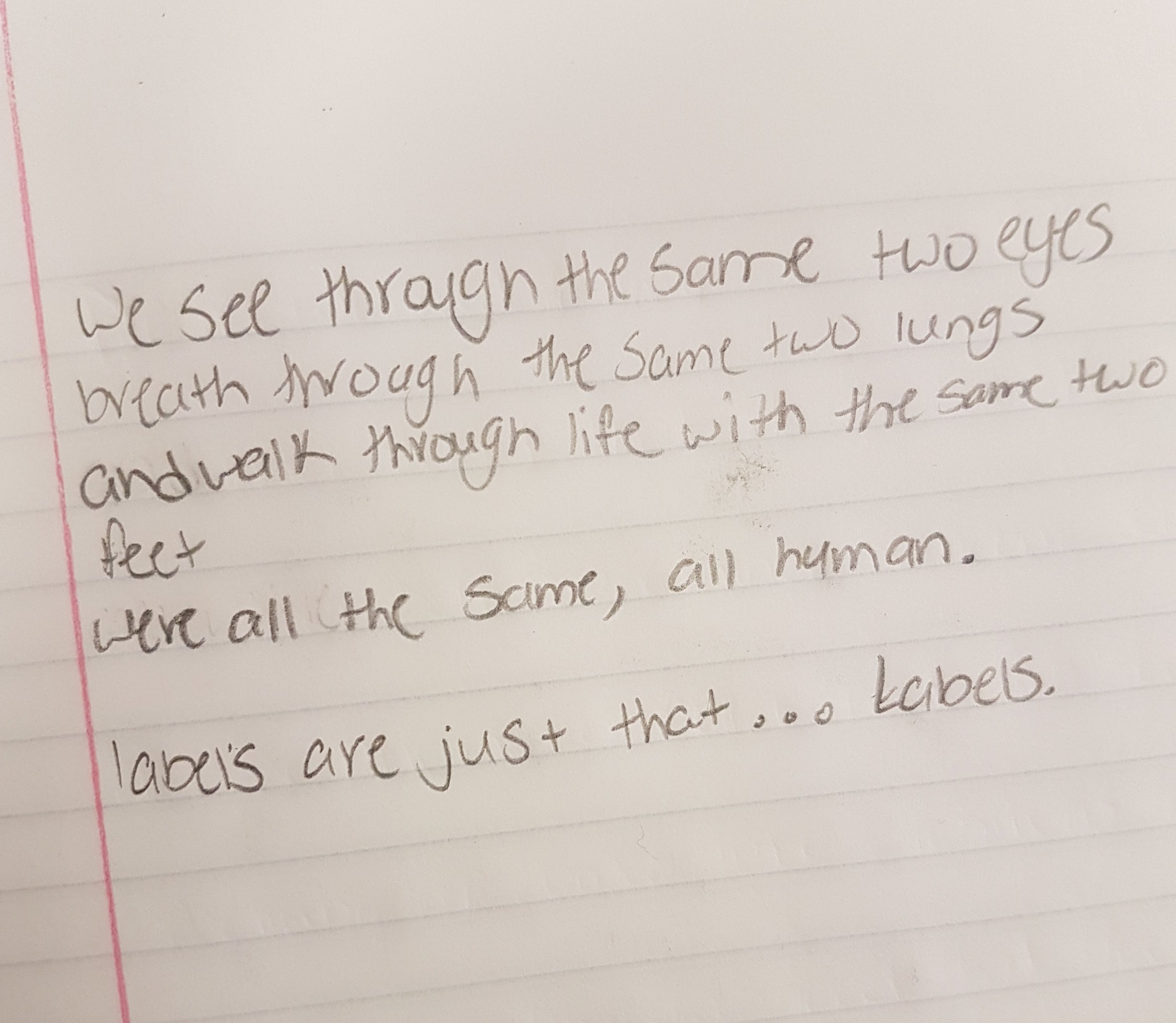
We see through the same two eyes/ breathe through the same two lungs/ and walk through life with the same two feet/ we're all the same, all human./ Labels are just that...labels.
As a side note: I want you to know, these students are smarter than us. Not only must they tackle high school crushes and uncool parents —they're also faced with the political turmoil of this era. Regardless, the future is in HD.
It's then, I knew —they get it.
The labels that are placed on us are just labels. We also pinpointed, this is where we get stuck most of the time.
When your loved ones tell you how you should act. It's not hard to feel trapped. When the media constantly tells you who you should be. It's not hard to understand why anyone could get lost. That's when honest language helps us to express the frustrations of the labels we wish not to carry anymore. It's there, right in that moment of truth, we can truly live out loud in our world.
Listen, this is not an intervention campaign just for 16-year-olds. The same goes for the adults. Whether you're in your 20's, 30's, 40's or 50's...
You have the right to choose and choose again —when you find out it's not what you need (whatever "it" is).
Just use honest language, "You’re not lost in life...You’re just early in the process".

The Sobering Reality of Paying Your Dues
The face of exhaustion, fear and paranoia will want you to suffer to pay your dues. Don't fall for it.

It's unlike the rooms I've walked into before.
Usually, new rooms are filled with hopeful energy bouncing off the walls. Rather, there was something dreary, sterile and beaten down about this space. Yet to put my finger on it, but in time I would have the answer.
As the days dragged, the thing I once couldn't put my finger on --slowly felt comfortable enough to reveal itself. And I opened up as it opened up. Beneath a well-put-together-facade was the face of exhaustion, fear and paranoia. It was the ugliest face I've seen in quite some time.
The type of face that rears its head when it's being challenged for its position. A rather shaky position but viewed as a challenge nonetheless.
Unfortunately, I wasn't there to battle.
Instead, reap the benefits of honing a craft when you're thrown into the trenches. Fine tune talents that have been aching for a bigger stage. And work on the mundane tasks that catapult success when the right moment arrives for you to strike.
No. This face of exhaustion, fear and paranoia wanted me to suffer like they did.
They wanted me to pay my dues.
"You haven't been here long enough."
"You're still a rookie in your field."
"You need to start from the bottom."
That's just how the system is or is it?
"You can't just show up and claim your position."
You must toil & labour for an inch of opportunity. Right? Even though you don't get what you deserve, you get what you accept.
Like I said, I wasn't there to battle.
Instead, honour my craft by knowing it's worth. Not compromising my integrity by doing the things I don't believe in.
Many times blind ambition will have you forget, even in the most comfortable position, you must still negotiate your value. Insisting that others will see or recognize your efforts and reward you in-kind, is a fool's errand.
The reality of paying your dues requires you to step up, not put up.
Putting up with low pay vs. stepping up to match the income you want.
Putting up with disrespectful attitudes vs. stepping up to create boundaries.
Putting up with the state of suffering vs. choosing differently and seeking peace by any means.
Very often, stepping up requires you to put your shaky position on the line. For not an inch but the grand opportunity to land on firmer ground.
The question is are you willing to pay those dues?

If You Were Thinking of Transitioning From Your Position...Pivot
Let's talk about transitions.

Death to Stock
Raise your hand, if you've made a move out of a position because it was time, it wasn't working or you felt stuck?
Throughout my biz journey, I've made a few extreme pivots.
There wasn't a ladder to climb up. More jungle gym, less straight shoot. Over and across, up then down. Zigzagging all over the place. But in my mind, there was no other choice. Even if I was met with a ladder, I would probably walk past it because we all know --success is never that easy. Honestly, I would think it was a trap.
Any ladder available for you to climb at your disposable is suspect.
You're missing all the necessary steps to engineer grit, resilience and faith. Now, by no means, am I telling you to choose struggle over an easier path. What I am saying is CHOOSE TO SHOW UP.
Many of us live in default mode.
Go with the tide and enjoy the ride type of vibe.
By living in default mode, we're also choosing to have things be decided for us --rather than being an active participant in your own life. For many years, I sat at a desk and worked in default mode. I came in and did the job outlined for me, went home then repeat the following day.
It felt normal. Safe.
It felt like this was what I'm supposed to be doing but little did I know...it was not. In fact, far from it.
The moment I woke up from my own "Inception" trailer. It was the same moment I delivered another human being into this world. No longer was it only about me and my future. I was responsible for someone else's too. When I recapped the showreel of my life --it wasn't what I wanted for this little person. But, I didn't quit my job.
I pivoted.
Quitting a job isn't always the next step answer. Although it feels hella good. It's a temporary feeling and then you wind up with another void to fill.
I pivoted my perspective.
Before I became woke, I was coasting. Content but not happy.
I pivoted my daily activities.
Instead of waking up every morning and struggling to crawl out of bed to start the day. I set my intention on how I wanted to feel.
Now, this ain't no woo-woo stuff...
And I'm not about to get all Iyanla Vanzant on you (the black & female Tony Robins for those who don't know). When I said to myself, "I will have gut wrench laughs and deep conversations today." I went out unconsciously seeking it. And every day I got at least one out of the two.
The days I got two out of two was where I found my joy.
Like attracts like.
I pivoted my attitude.
People I never spoke with before in the 5 years I worked at my job became lifelong friends, inspiration and even my clients today. That opened up more conversations which led to new opportunities.
The same goes for your business.
If it feels like it's time, it isn't working or you feel stuck...don't quit --pivot.

When "It's Out of My Budget" is Code For "You're Too Expensive"
It's not that you're too expensive. It's that...they don't see the value, yet. Here's how to flip the script.
[ short answer ]
What should you do when a client says "it's out of my budget"?
Treat "it's out of my budget" as "I don't see the value yet," not "you're too expensive." Go back to your call notes, find where the disconnect happened, and ask about their concerns. Then repeat back what you heard, highlight the benefits, and show how their situation improves. Most clients are weighing money saved, return on investment, and results they can brag about.

The process to onboard a new client goes something like this:
- Client reaches out to you about your services.
- You send them a self-assessment to determine if they're emotionally & financially prepared to invest.
- They are.
- You get on a call with them to talk details.
- You send out a proposal or contract.
- There's pushback, "It's out of my budget."
Uhhh, wait...what?!
What do you do?

Look, it's not that you're too expensive. It's that...they don't see the value, yet.
We've all been here at some point. Matter of fact, it's not too long ago ---I was here. I didn't freak out. I just knew I hadn't properly shown the value. It is our job as service providers to show how our service solves a problem.
In these scenarios head back to the drawing board. Pull out your notes from the initial call or assessment and figure out where the disconnect occurred. Then reach back out to get clarification on their concerns, fears, or reservations.
Listen.
Then paraphrase their concerns, highlight the benefits, and walk them through how their life will be different after investing with you. Keep in mind, as you speak one or all three of these questions will linger for the client.
MONEY: Will this save me money in the long run?
ROI (Return on Investment): Will my situation improve?
SOCIAL ACCEPTANCE: Will I be able to brag about my results to my friends/colleagues?
Communication is key in these scenarios because it could be a variety of reasons why the deal went sour:
- A client may not have shared all the details of their problem
- A client may have said one thing but meant another
- A client may need to answer to a higher up and isn't the decision maker
- A client may be shopping around for the best rate
- A client may have thought you would be nice to have but your service isn't a need at the moment
- A client may not fully understand what they're buying & how their situation will improve
If you put yourself in your client's shoes and play out what they may be thinking, you'll quickly begin to realize, they're very much excited to improve their current situation but at what value?
In the midst of COVID-19 (May 2020), I chatted with the Halton District School Board. They reached out for me to share my communications and marketing career journey. The first ten years of my professional life was in a job instead of a career, had I received this insight at high school, I would already have the awards and wealth that match my work ethic.