

Learning ai is a trap (if you’re a founder, here’s what to do instead): Guess less. Grow more with this Notion dashboard.
I can operate like I have a team of five, and sleep like I only have one.
[ short answer ]
Should founders learn AI?
Don't start by learning AI. Start with your friction points: the tasks that take the most time for the least return. Fix your systems first, then give AI only the jobs you hate, like turning client calls into drafts or automating new-client setup with tools such as Notion AI, Zapier and Asana. Treat AI like a new hire you train, not a shiny new toy.
Honestly. I didn’t start with Python or agents, I started with the bottlenecks in my business.
For me, the question wasn’t “How do I learn ai?”
It was: “Where am I spending way too much time for way too little return?”
That turned out to be:
Writing up client notes from scratch after every first call
Walking every new client through the same setup steps, by hand, every time
Scrambling each week to figure out what was working
So I treated AI like a new hire rather than a shiny new hot toy. I trained it, and I only gave it the jobs I hated.
I didn't build anything from scratch. I just:
Used ChatGPT to turn client convos into content drafts
Set up Notion AI + Zapier + Asana to handle new-client setup
Saved prompts for the recurring tasks I dreaded (and also, I’m not a prompt engineer)
And let me be clear…I still don’t know how to code. But now I can operate like I have a team of five, and sleep like I only have one.
If you’re a founder, I’d say, don’t start with ai. Start with your friction point. Improve your systems. Then build out your tech stack from there.
This is your semi-comprehensive guide when you’re stuck on where to start!
The founder's dilemma
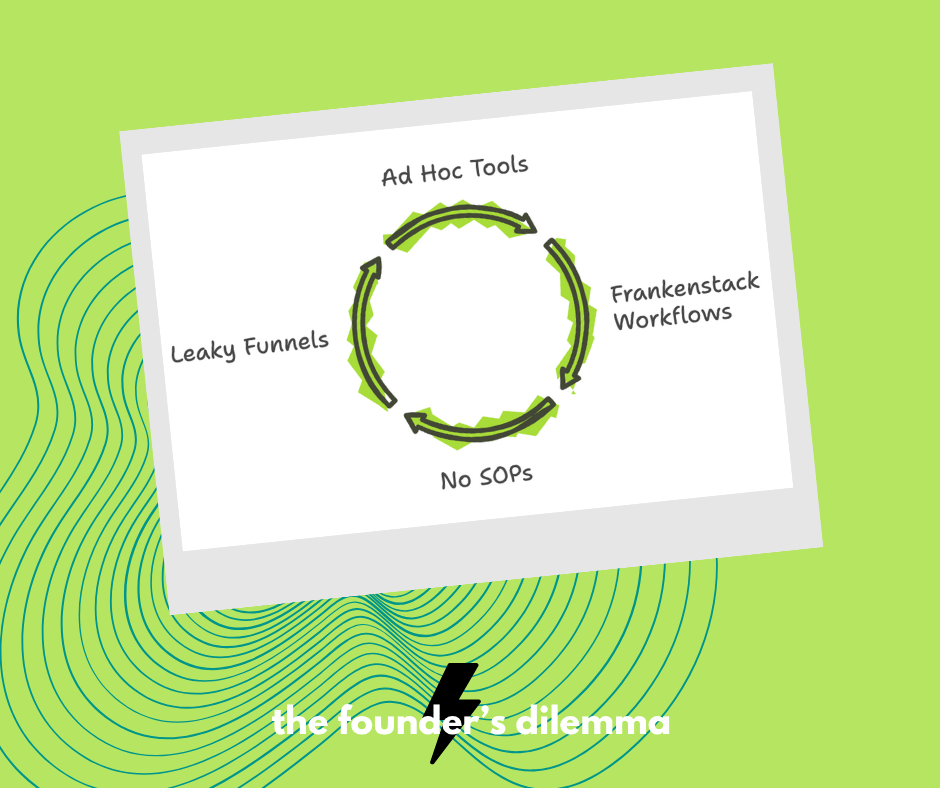
Ad Hoc ToolsA booking app a friend recommended, an email tool from a free trial, a spreadsheet from 2019. And none of them talk to each other.Even big marketing teams use just 49% of what their marketing tools can do. (Gartner 2025)
Frankenstack WorkflowsTools duct-taped together that snap the minute you get busy or try something new.
No written how-tos (SOPs)The steps live in your head, so every sick day turns into a guessing game.
Leaky Follow-up FunnelsClients slip through the gaps between the booking app, the inbox and your memory.
⚠️ The result: you’re spending time and money bringing people in, and you can’t tell which part is paying you back.
The case for marketing-led ops
What is Marketing-Led Growth? In plain English, your marketing looks after the whole trip a client takes with you:
Finding you (demand generation)
Booking the first time (customer acquisition)
The first visit (onboarding experiences)
Coming back and bringing a friend (retention & advocacy)
You can own every marketing software on the market and still have nothing that brings the same client back twice. Software sits still until something tells it what to do.
That something is your system: who sends the text, when, and what it says.
Why Marketing Should Steer Your Operations Early
Software companies love debating whether the product or the sales team should drive growth (insiders call it PLG vs. SLG). Your business gets to skip that debate. Your marketing is the only thing talking to clients when you’re not in the room, so let it steer:
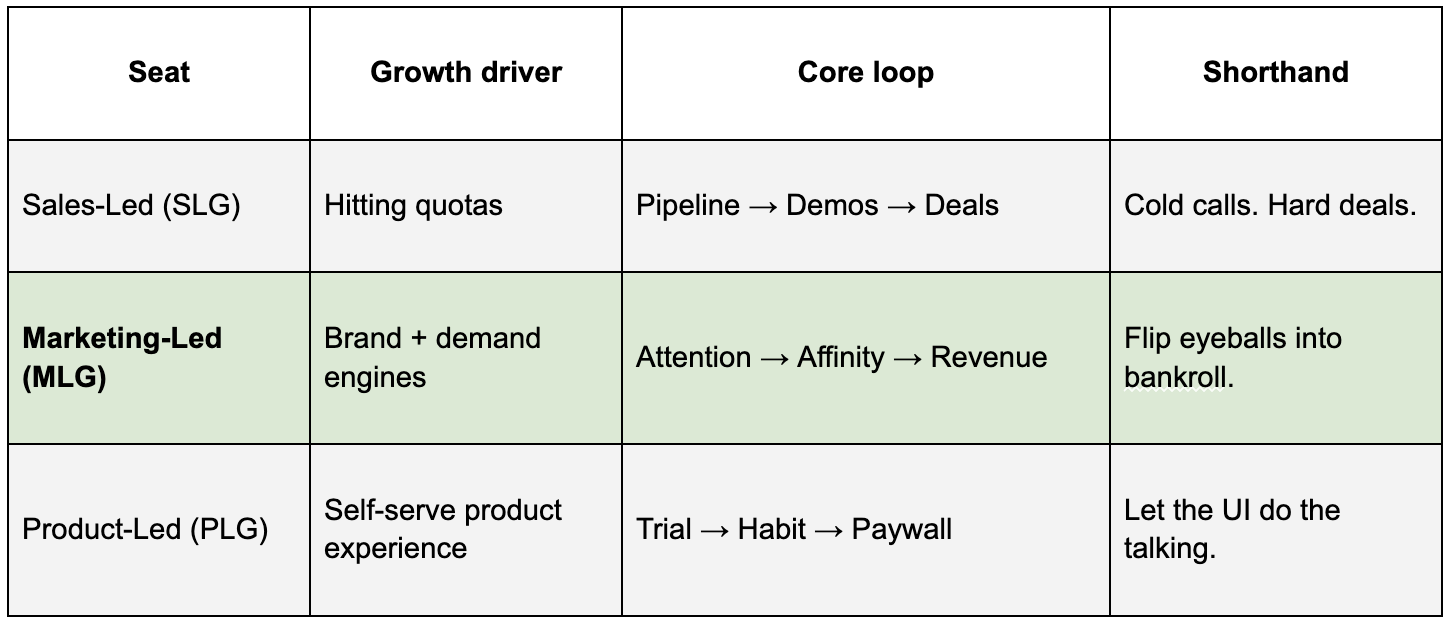
Marketing owns the full-funnel customer journey.
Revenue clarity from lead to expansion.
Faster experiment-to-scale cycles.
Marketing-led growth bets that good storytelling, a bit of community and a little ad money can walk someone most of the way to booking before you ever say “hi.”
3 companies that made marketing the prime growth engine
Hubspot, B2B Software as a Service (SaaS)
The godfather of “inbound” content. Taught the internet for free with blogs, courses and a podcast, years before anyone was talking about product-led growth (e.g. HubSpot Academy). They have my email at least 987 times.
Steal this: answer the question clients ask you every week once, in public, and pin it.
Canva, Consumer & Enterprise SaaS
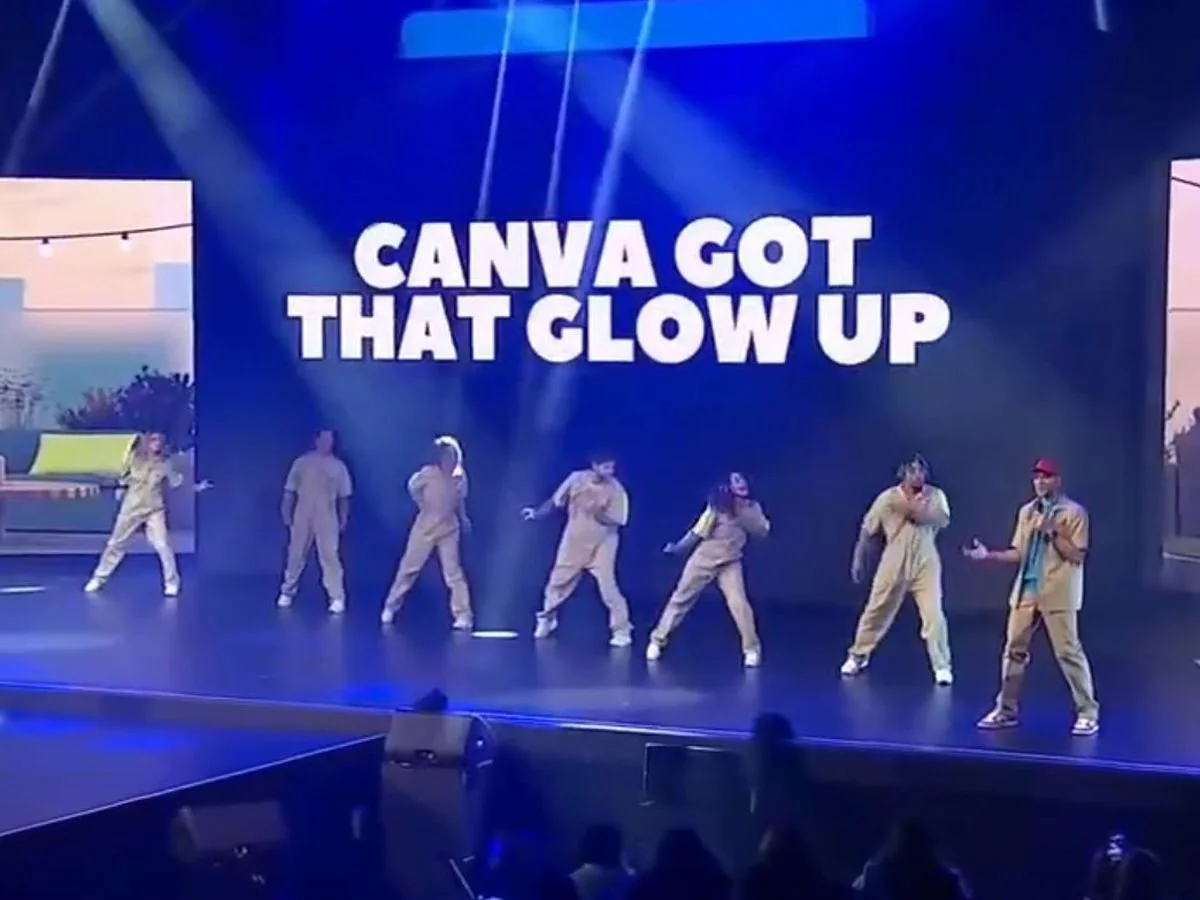
Made design feel doable for everyone: “Design for the 99 %”. Narrative + viral template marketplaces + headline partnerships (Pinterest, Leonardo.ai). Mic drop.
Steal this: make the thing clients love easy to pass along, like a gift card or a referral link.
Duolingo, Consumer SaaS
Let a 23‑year‑old run TikTok. Leaned into mascot comedy, real‑time memes, and creator collabs. Need I say more…?!
Steal this: the funniest person on your team probably shouldn't be the one stuck answering email.
The 3-layer setup you need
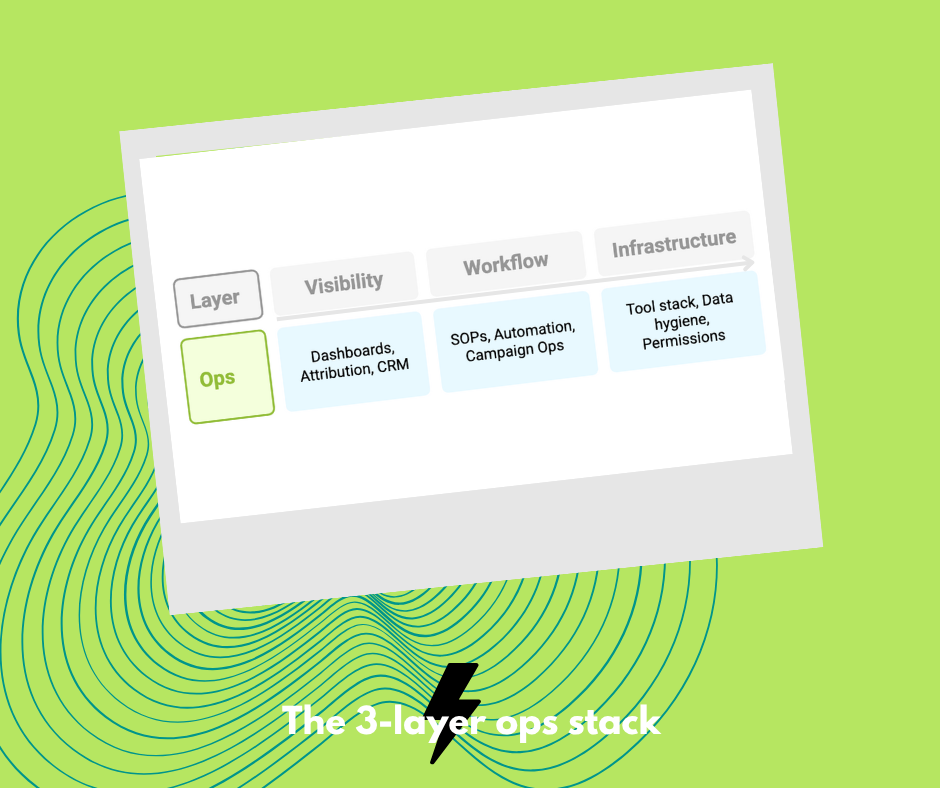
Visibility: can you see it? Who booked, who came back and what brought them in. A simple dashboard, your booking app's reports and one client list cover it. (i.e. Dashboards, Attribution, CRM)
Workflow: does it happen without you? Written how-tos, automatic reminders, and a plan for what goes out each month. (i.e. SOPs, Automation, Campaign Ops)
Infrastructure: will it hold when you're slammed? One booking tool, a clean client list, and a clear answer to who can log into what. (i.e. Tool Stack, Data Hygiene, Permissions).
Ops shortcuts for owners who do it all
All four are low lift. Pick the one that bugs you most.
A Notion tracker for your promotions
🟡 Low lift/⚡️High impact
Plan, track and measure every promotion with pre-built templates in one dashboard. Easy to connect your tools via embeds or APIs.
Single Source of Truth Doc (also known as the holy grail)
🟡 Low lift/⚡️High impact
Create one master document with all critical business data points: promotion UTMs, CRM fields, audience segments, and brand assets linked in one place.
Zapier Recipes for Lead Routing
🟡 Low lift/⚡️High impact
Send website form entries straight to your client list, a follow-up email and a team alert, with no code.
Loom Video Training
🟡 Low lift/⚡️High impact
Record yourself doing a task once. The next new hire watches it instead of shadowing you for a week.
The 60-minute check-up (for owners who don’t do tech)
Pinpoint what’s breaking behind the scenes before it slows your growth.
Run this audit to help you spot the operational blind spots holding your marketing back. So you can fix what’s messy, automate what’s manual, and scale what’s actually working.
Promotions: Is there a system to launch campaigns?
✅ Documented campaign process exists (i.e. a brief)
❌ No centralized campaign calendar
❌ UTM tracking links are inconsistent or missing
✅ Team knows their roles in campaigns (i.e. a RACI)
Quick Fix: Download The Flow State and get a promotion brief you can implement immediately. Hit the subscribe button below.
Customer Data: Is there clean CRM hygiene?
❌ Lead sources aren't tracked consistently
❌ Duplicate contacts exist
✅ Contact fields are standardized
❌ No regular data cleanup process
Quick Fix: Run monthly data hygiene checks with your tool’s duplicate management system, or a simple spreadsheet audit via Chat GPT.
Reporting: Can you see what's working in under 5 clicks?
✅ Key metrics are clearly defined
❌ No single dashboard for KPIs
❌ Campaign ROI calculation is missing
❌ Data spread across multiple tools
Quick Fix: Set up a dashboard in your preferred CRM tool with your top 5 marketing metrics.
Follow-up: does anyone hear from you after the first visit?
❌ No thank-you note goes out the same day
❌ Review request in place
❌ Rebooking reminder lands before they’d normally be due
❌ Tracking who hasn’t been back in 90 days
Quick fix: turn on your booking app’s automatic review request after each visit.
Key workflows to set up first
Start with the jobs you repeat every week. Lock those in and everything after gets easier.
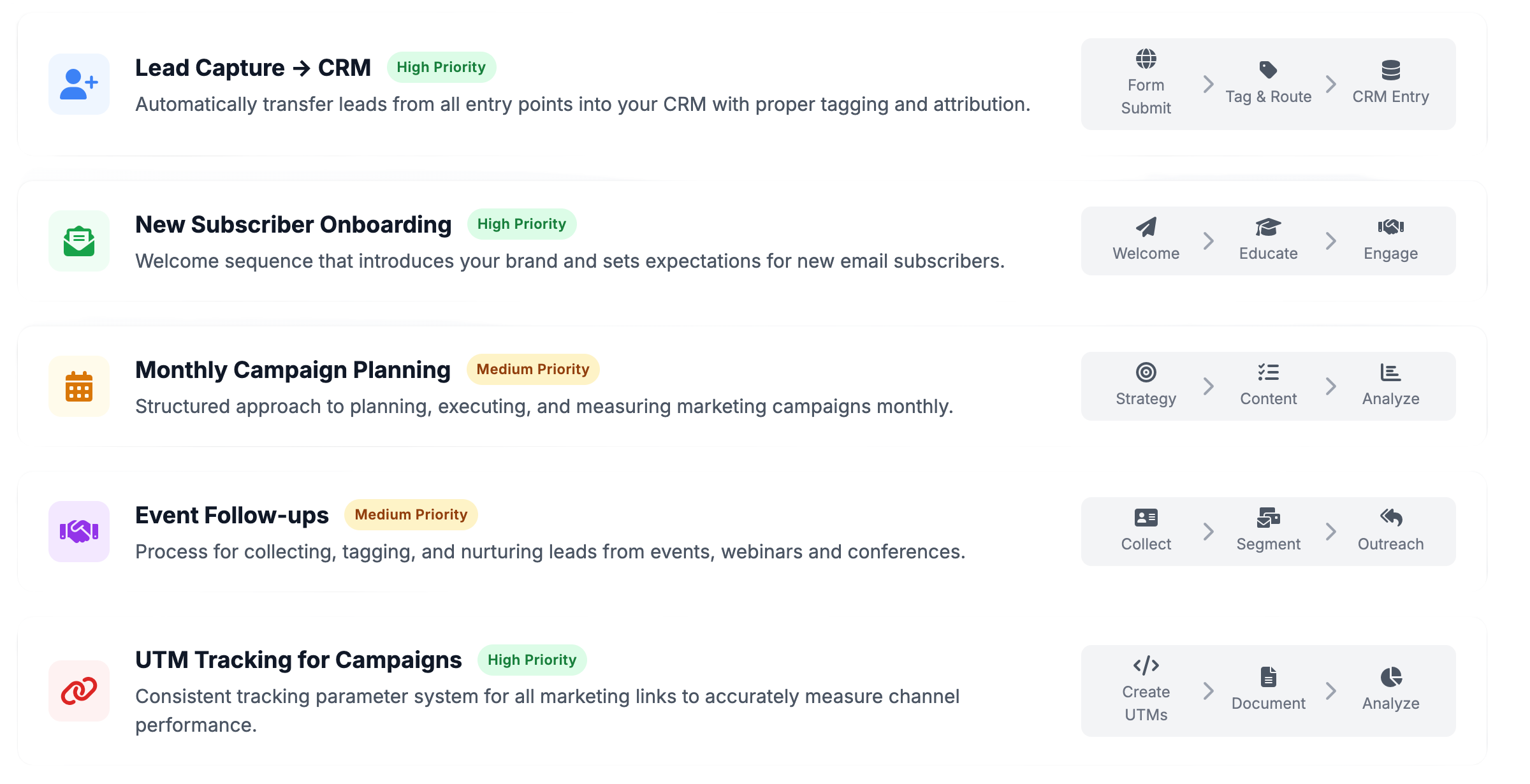
Templates & Swipe Files
Skip the grunt work. If you spend more time figuring out software than using it, I made these plug-and-play resources to get your marketing running.
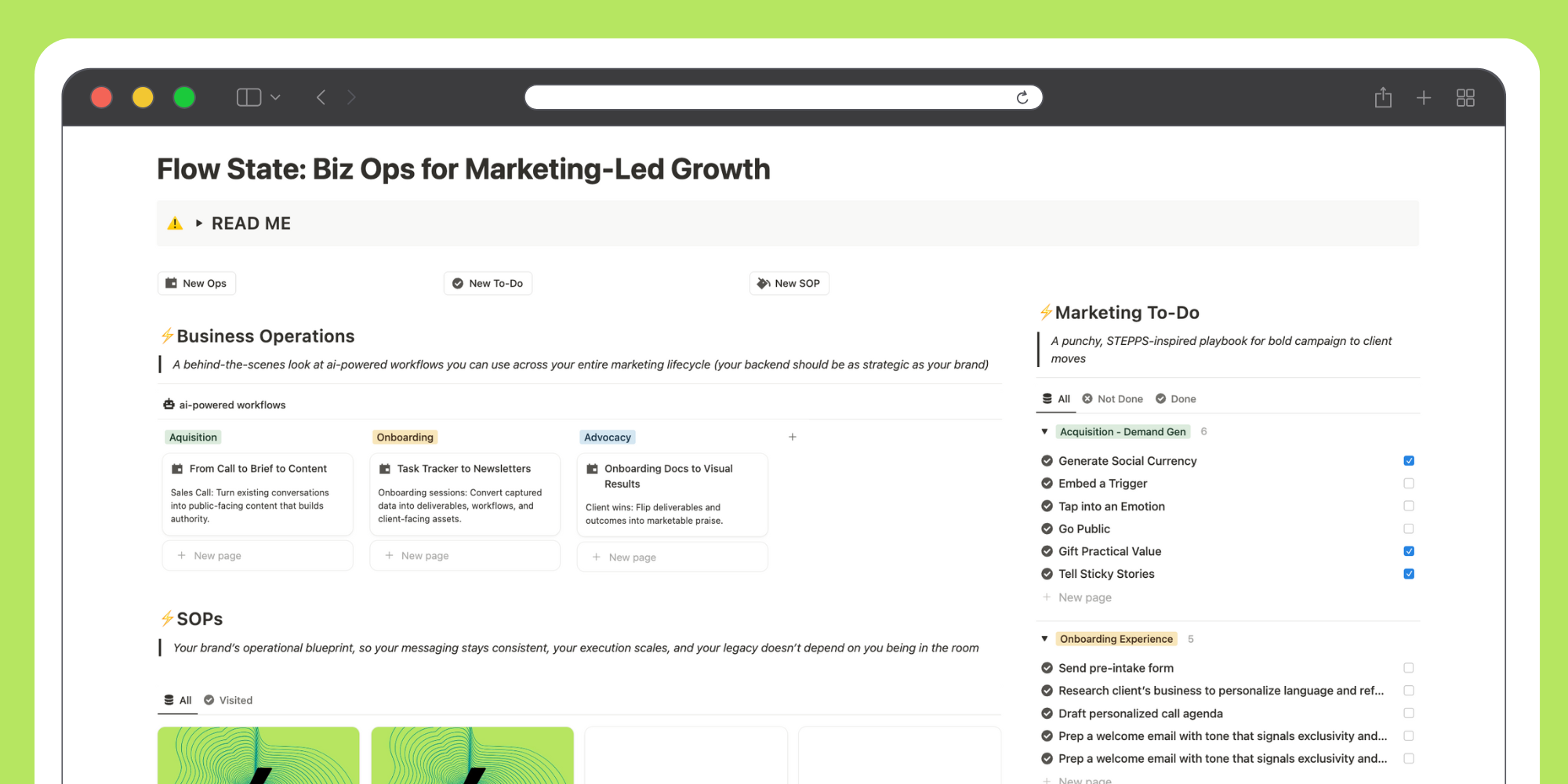
We can continue to build on this dashboard together.
I help founders set up their first ai-assisted workflow to finally see what marketing is working, what’s wasting money, and free up 10+ hours a week doing it.
Before you open another AI tutorial, pull up last month’s bookings and circle every first-time client. Then count how many have booked again. If that number makes you wince, you’ve found your friction point, and it’s where I’d start.
Now, let it resonāte,
Tennile

Obsessed-Like: "Because you watched…" Netflix does it. TikTok does it. but Pinterest does it best.
Pinterest Predicts? More like Pinterest Programs.
Guest post by Kiyosha T
Editor’s Note: Ever wondered how TikTok influencers set trends, and Instagram is trailing three months behind? Kiyosha, a social media strategist with a love for spicy campaigns and bold brands, has a knack for uncovering how niche culture collides with the mainstream. So, of course, I tapped into her and she followed the breadcrumb trail—past the influencers—into a silent data vault where billions of whispers decide tomorrow’s obsessions months in advance (weeell before TikTok). This is our first #HypeWatch guest post of Don’t Believe the Hype. 😆 — Tennile
Pinterest Predicts? More like Pinterest Programs.
Trends often masquerade as spontaneous expressions of taste or originality. But a closer examination of how they emerge, when they emerge, and who benefits from them, reveals something else entirely. These seemingly organic aesthetics are often shaped well in advance, backed by data, and quietly nudged into our feeds under the guise of discovery.
Each year, Pinterest releases Pinterest Predicts, its flagship trend forecasting report that functions less like a cultural weather report and more like a strategic blueprint for how consumers will be guided—intentionally or not—toward certain products, aesthetics, and identities. While it reads like a visual lookbook, it’s essentially a streaming platform serving up aesthetics as Next Up suggestions, just like Netflix.
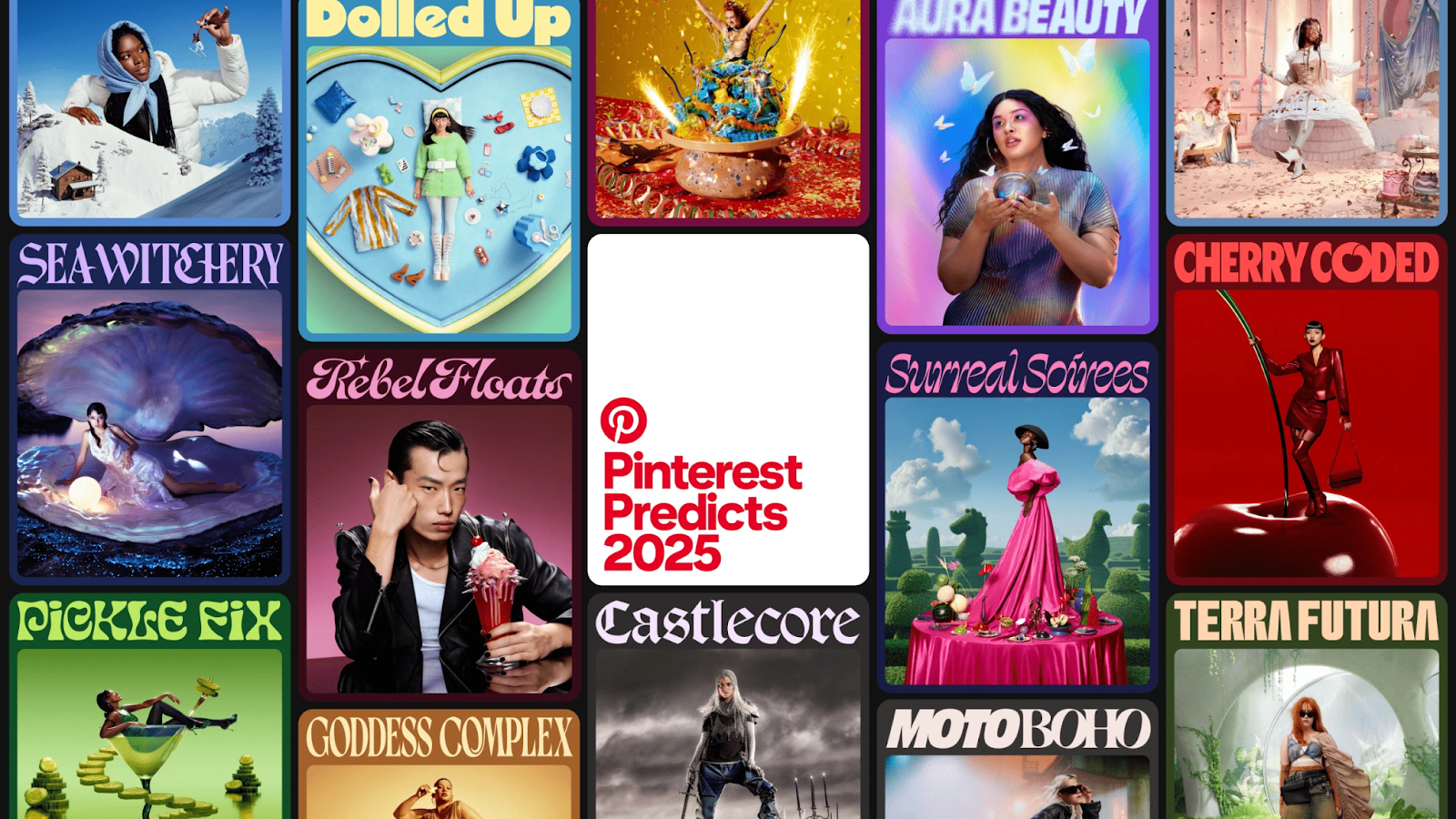
Pinterest predicts 2025
Pinterest is plotting on your new obsession
Make no mistake: Pinterest is not your quirky friend suggesting you try something new—it’s a corporate blueprint built from billions of data points, designed to steer the next 6 to 12 months of consumer behavior.
According to Pinterest itself, the report boasts an 80% accuracy rate.¹ That means 8 out of 10 trends they include do, in fact, go on to dominate timelines, moodboards, and marketing decks alike.
The reason for that isn’t magic—it’s momentum.
Pinterest has quietly positioned itself as one of the most powerful platforms in visual culture by tracking what people love; they’re nudging it forward, polishing it, and handing it to brands who then run with it.
Looking at you Jacquemus.

Let’s be honest. “Predicting” a trend only works if you’ve got enough power to ensure it actually happens. Pinterest does. And they wield it with surgical precision, down to which colours you can expect to see IRL and in-feed.
Here’s the process: Pinterest analyzes billions of pins and searches to identify the low-simmering interests bubbling just beneath the surface. Then, Pinterest selects a curated handful of these interest clusters, gives them a clever name and publishes them in a way that feels playful and inspiring, not prescriptive.
But the second that report hits? Marketing teams grab it. Agencies rewrite their decks. Influencers pivot their content plans. The ripple effect is immediate and strategic.
This is how you end up with the same trend popping up from different creators, continents apart. Pinterest uploaded the aesthetic into the cloud, and everyone—from your favourite stylist to your favourite snack brand—downloaded it.
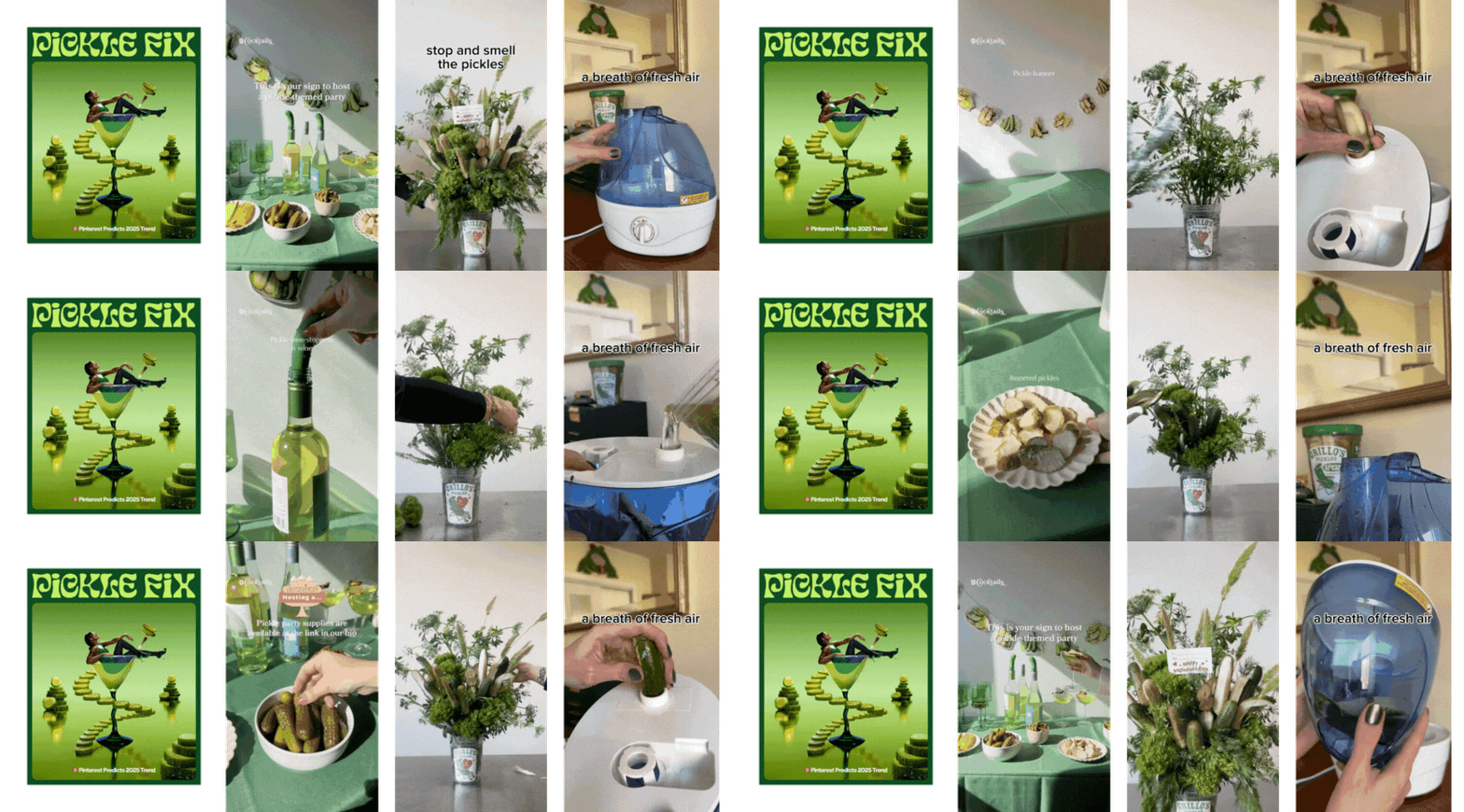
Pinterest Predicts: PICKLE FIX
Why Pinterest Predicts exists (hint: it’s not for you)
Pinterest pitches the report as a helpful, inspiring tool for businesses. But what it really is… is leverage.
Pinterest Predicts allows the platform to insert itself into marketing cycles at the ideation stage. It positions Pinterest not just as a social media platform, but as a cultural authority—a kind of aesthetically pleasing puppet master pulling the strings behind your next product launch, influencer collab, or runway trend.
Here’s what it gives businesses:
Trend Forecasting: Real-time behavior is analyzed and extrapolated to predict future interest.
Creative Inspiration: Think: We saw “Seeing Double” in Pinterest Predicts. Let’s mirror our homepage for the new drop.”
Early Advantage: Brands that adopt early win clout points for being “in the know.”
Data-Driven Validation: Every aesthetic shift comes with a spreadsheet to back it up. It’s creativity with receipts.
The brilliance of it is how non-threatening it all feels. Pinterest isn’t demanding you follow their trends. They’re just putting them out there…surrounded by soft gradients, handwritten fonts, and clever titles that make the marketing feel like a moodboard.
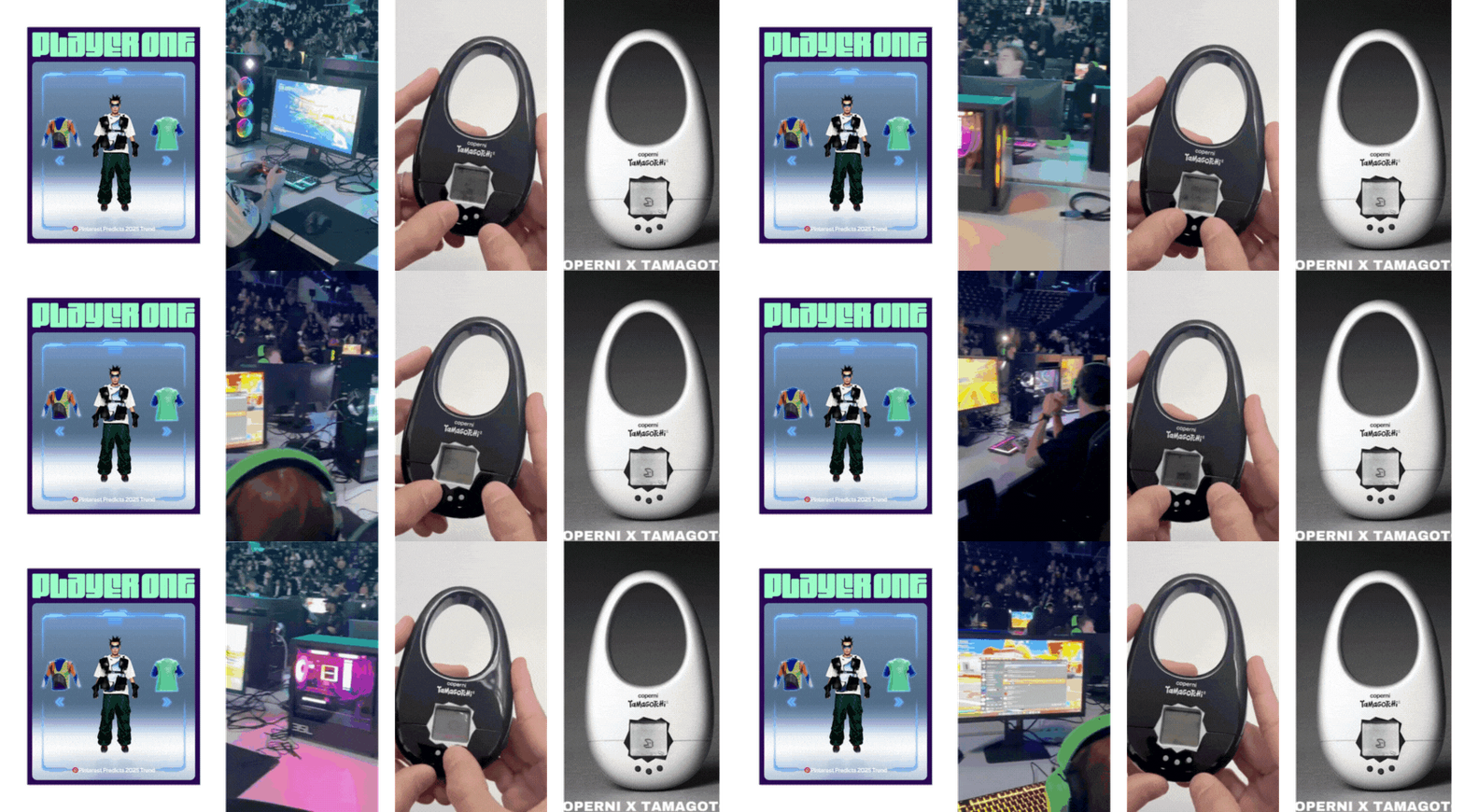
Pinterest Predicts: PLAYER ONE Coperni’s Paris Fashion Week Show and Limited Edition Tamagotchi
Who’s actually winning here?
Spoiler alert: it’s not the creators doing the cultural labor. It’s not the small brands trying to ride the wave after the crest. And it’s definitely not the Black and Brown communities whose innovations so often serve as the unpaid R&D department of the internet, only to see their work laundered through a sanitized, Pinterest-approved aesthetic a few months later.
The real winners are the players who sit closest to the money.
📈 The big dogs: agencies, retailers, brands
Once Pinterest Predicts drops, big brands are already mid-rollout—SKUs approved, shoots wrapped, and product lines built around trends before the public even clocks them. Agencies remix those same forecasts into high-ticket strategy decks, slapping on buzzwords and cashing in on ideas creators made viral for free. Retailers and pop-up curators close the loop, turning Pinterest moodboards into fully shoppable spaces.

Pinterest Predicts: PEAK TRAVEL Topicals x SLS Influencer Ski Trip and SKIMS x North Face Ski Collection
The CTAs in the report clearly have marketers in mind, as Pinterest is positioning itself as a supporter in helping brands build strategies around these trends.
Meanwhile, the people making the trends feel alive—the creators, the style innovators, the niche communities on the edge of culture—are often left in the dust.
They’re often reduced to being “early adopters.” Which is wild, because in many cases, they’re not early adopters.
They’re the blueprint.
But platform culture doesn’t reward origin. It rewards distribution. It rewards palatable. It rewards scalability.
So, unless you’re tied to a brand, an agency, or a platform with media muscle, your cultural capital often gets extracted, then erased, then sold back to you as a rebrand.
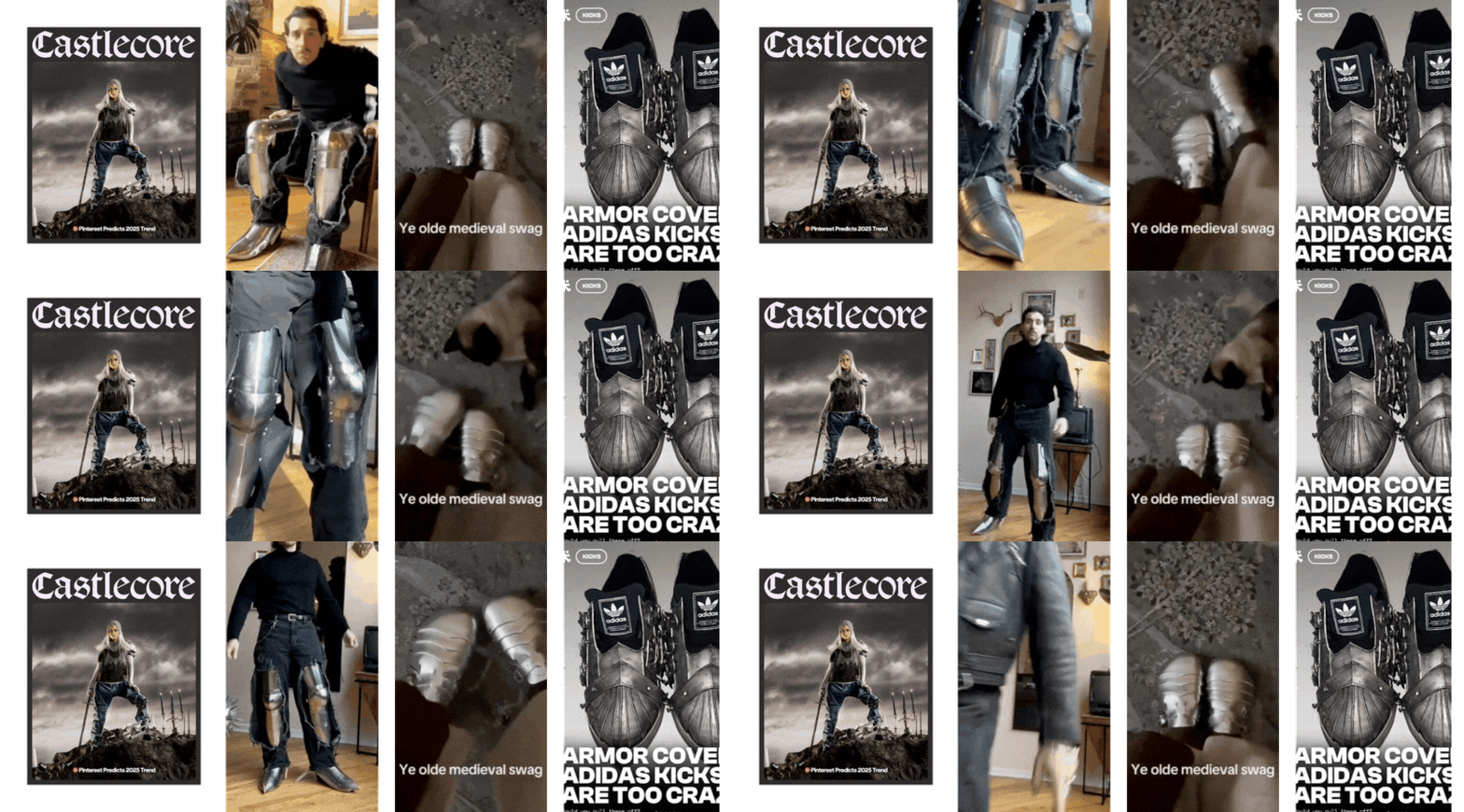
On the flip-side: we owe Pinterest their flowers
You gotta give it up to the Pinployees, they’ve managed to consistently bring the hype to fruition in a way that feels weirdly specific, inclusive of niche interests and also easy enough to participate in.
Moving like a publisher, retail outlet, and cultural producer, all at once?
I can tell you right now, if you’re still treating the Pinterest Predicts Reports like any other trend round-up, you’re gonna miss the rollout.
As marketers, we gotta ask ourselves:
Are we studying how the trend is moving, or just jumping on it once it’s already arrived?
Who’s actually at the center of the trend we're amplifying—and who got erased in the rollout?
What would it look like to partner with the source of culture, instead of just packaging the aesthetics for profit?
Because once Pinterest drops a trend, the chain reaction is set:
A Pin becomes a post, the post becomes a campaign, the campaign becomes a carousel, the carousel becomes a cart—and the cart? It becomes your target audience’s personality.
This isn’t random.
This is Because You Watched Culture™.
So quit playing with Pinterest and get with the programming.
They’ve already queued the Next Up suggestions:
📺 Sci-Fi: Urban Decay SG1: Sea Witchery
📺 Feel-Good Comedy: Uber to the Nesting Party
📺 Period-Drama: Chappell Roan’s Rocco Revival
Now you know what trend is up next!
👋🏾 Soooo…collective illusion is public enemy number one—Don’t Believe The Hype. Every so often, we’ll say the quiet parts out loud (in your inbox). So we can cancel or co-sign marketing or market trends and discern pop culture gems from flops together. And start making sense of the nonsense online.

Ready-Like: Let’s call it what it is: ai colonizing
ai is coming for your job. But first, it’ll colonize your expertise.
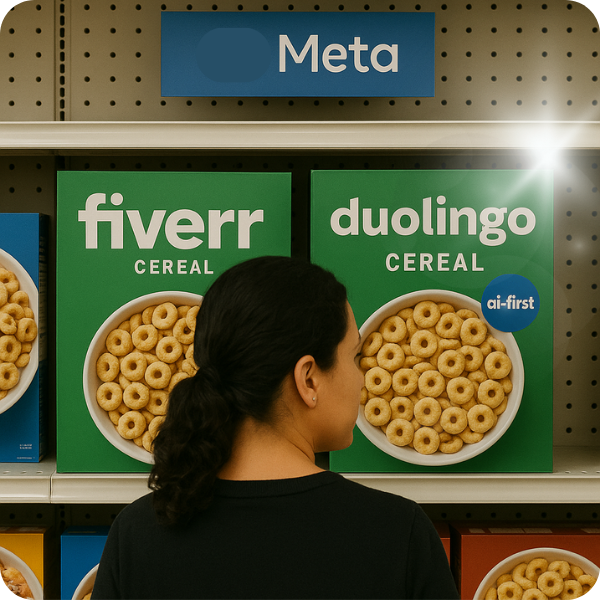
ai is coming for your job. But first, it’ll colonize your expertise.
Oh, the fear of ai permeates our nostrils.
You can’t scroll for more than two posts on LinkedIn without bumping into somebody talking about chatgpt em dashes (—) or an ai-generated action figure graphic.
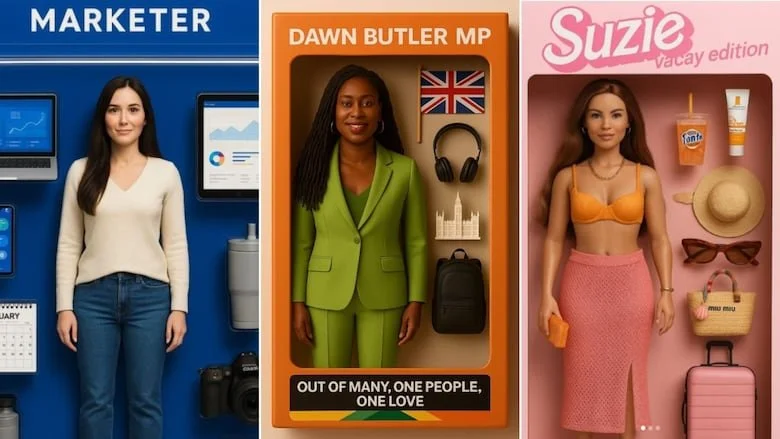
Why is everyone suddenly a doll? Newest AI trend is more than harmless fun (CBC)
Like this one LinkedIn poster, a Creative Director—in fact—identified that if they don’t learn a new ai trick fast and in a hurry, they will be replaced. After posting an ai-generated model with human-like imperfections, their practice ad faced backlash for ai’s use instead of a real person. “Because I need to learn new skills and practice, otherwise I'm going to be replaced too…”
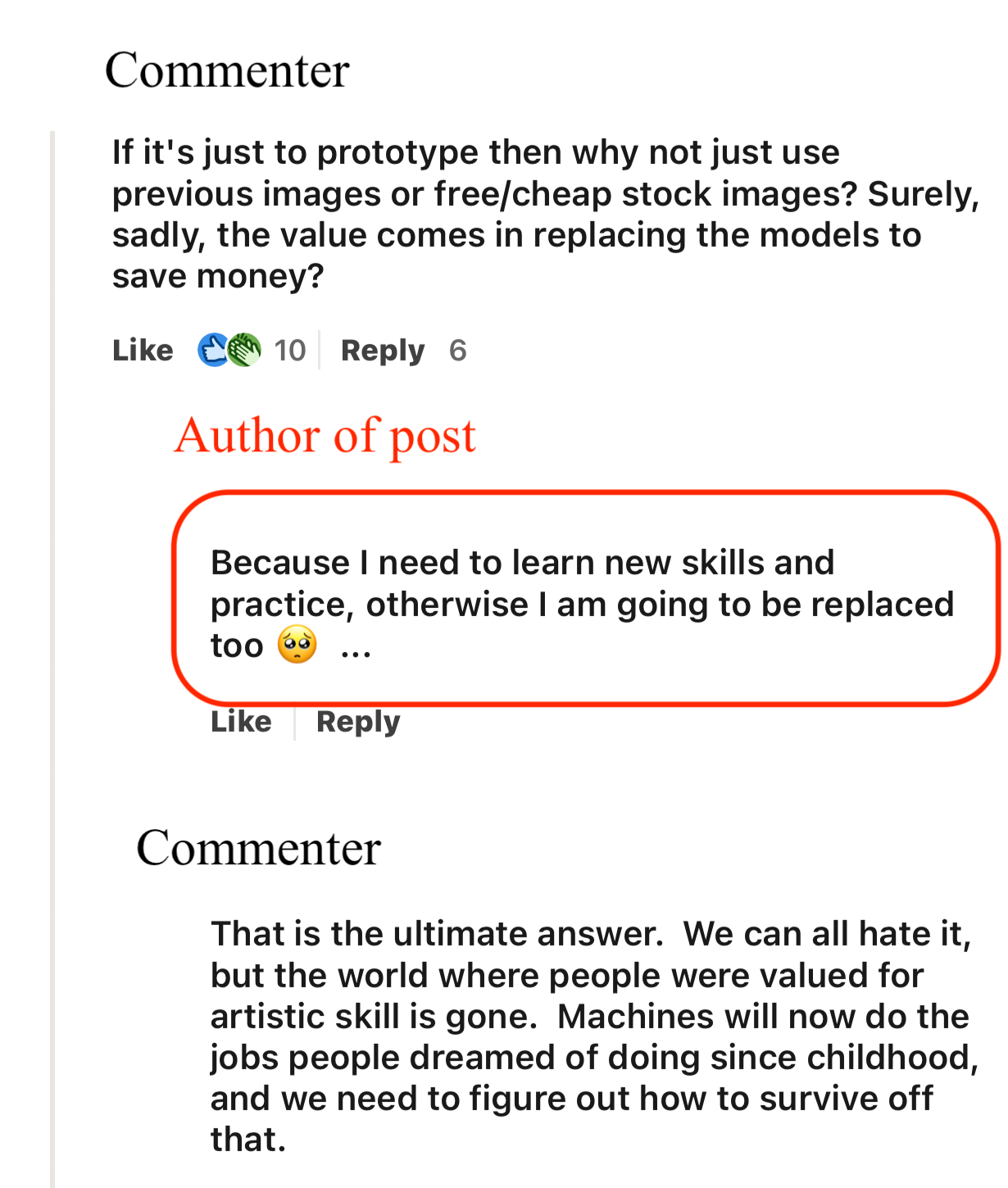
A LinkedIn poster expresses ai concerns
That’s what this entire article is about. And I have a lot to say about the topic.
fear-mongering?
About a month back, Micha Kaufman, Fiverr CEO (the company that did a commercial jingle on “nobody cares if you use ai” with their freelance marketplace but, it turns out, we do. Them. I wrote about it here). Sent an email to staff, exclaiming that ai was going to take their jobs. Including his own.
He was even bold enough to share that same email on Twitter (X).
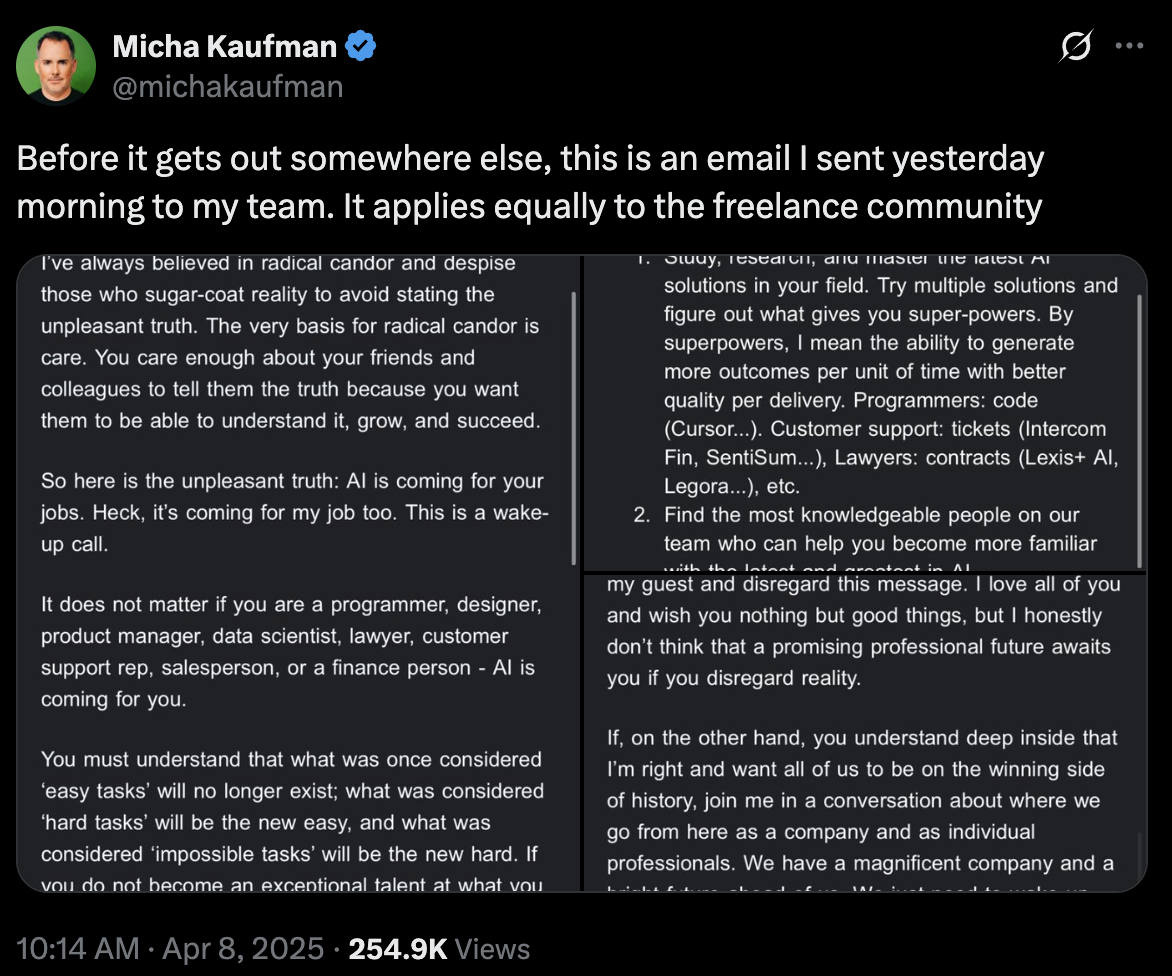
source: X
And honestly…*slow claps*.
I agree.
We collectively, WE, downplay the power and the dangers of ai. It’s not just out for our jobs, THAT’S only the casualty. It’s out for US. Our identity.
*Type this into chatpgt right now: “What are the threats of ai. Be honest,” and see what it says.
ai learns from human data. Us.
ai learns art, writing, language, music, voice, video, code, law.
ai learns bias, racism, sexism, classism, and every other -ism.
ai then optimizes it and repackages it.
Sounds a lot like colonizing, doesn’t it?
As much as there is good in how it can supercharge us in our work and life…there are unspoken threats. And when you do speak up on the threats, you’re fear-mongering. Like in the Fiverr CEO’s case.
But deepfakes are a real, present reality.
Forget fake news. Imagine even faker people. Not fake like your sister’s BFF who acts like a Stepford wife. I mean ai generating entire political speeches, protests, or war crimes that never happened, all in HD with the voice to match (see the movie G20 with Viola Davis for an eerie representation).
Don’t believe the hype…at least not all of it.
ai-first?
Duolingo, everyone's favorite psycho bird. And language learning app recently fired all their contractors (first translators, then writers) and replaced them with ai.
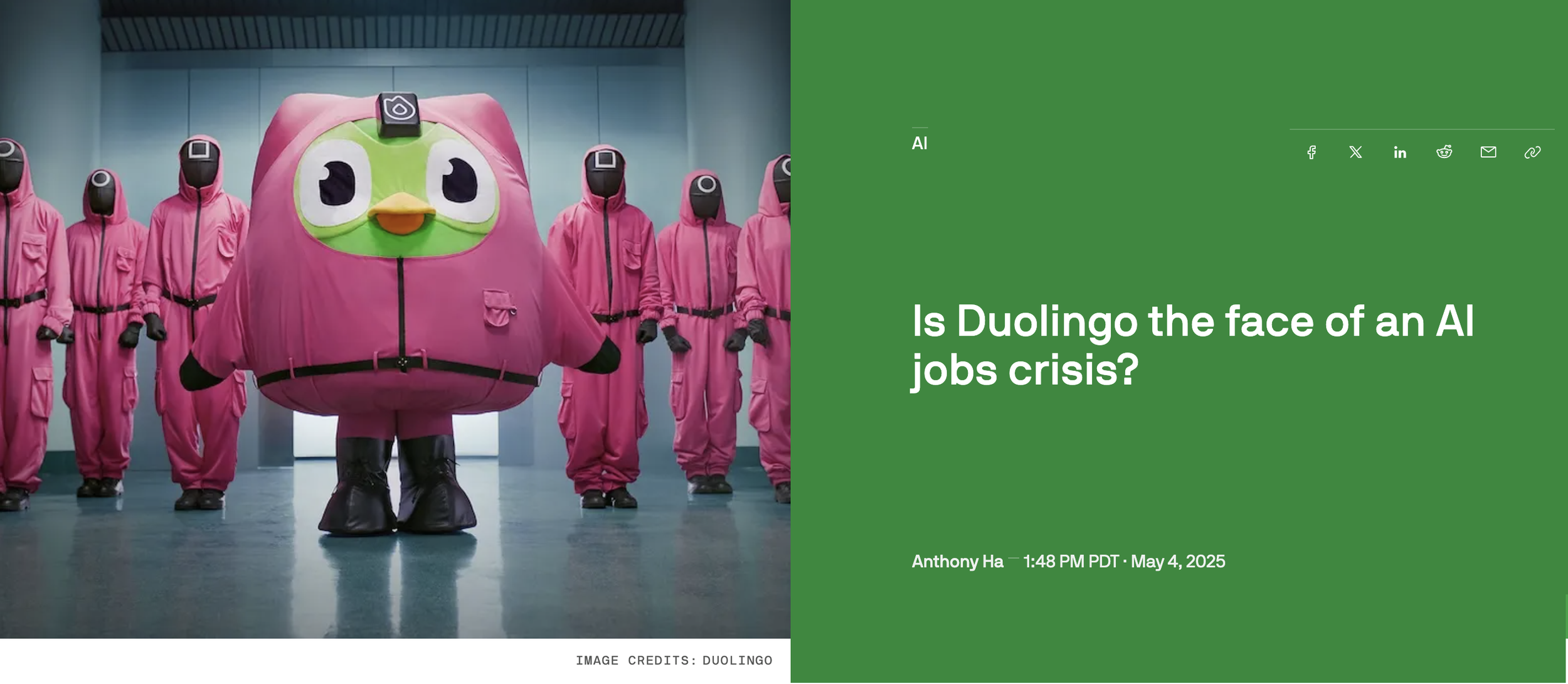
Source: TechCrunch
Let me write that again: They fired translators.
Professionals closest to the cultural language, so you feel like you’re learning authentic dialect instead of playing a game of linguistic charades. And for that lovely trade-off, we get 148 new language courses generated by ai. What would’ve taken them 12 years to accomplish, they did it in one.
Hip hip hooray!
This is what it means to be an ai-first company. It’s oddly similar to a profit-first company. The similarities are uncanny.
But before you write me off as sounding bitter about it, I want you to know that I am a Duolingo Devotee.
This criticism comes from a loving place for their on-the-pulse marketing and how they’ve set the bar for employee engagement. I am challenging them to think bigger and be braver in their language learning approach.
They could’ve built an immersive program for learners. Connecting learners to native speakers in their home country (I see an Airbnb partnership).
They could’ve leveraged the translators to create paid micro-courses focused on regional slang, idioms, and cultural references too.
They could’ve created Duolingo Originals. Web-based series that help learners grasp the language through telenovelas (hello, Netflix or maybe YouTube).
They could’ve made contractors in-app coaches as a paid upgrade.
They could’ve struck up EdTech licensing deals with schools, orgs and governments.
“Instead of shrinking their soul to scale,” ← ai said it, not me.
But I’m sure the smart Duos over at Duolingo already pitched these alternatives with the caveat that none of the above can be done fast and in a hurry. However, short-term tactics over long-term ones will have you fighting for your messaging life. Profits to follow.
It’s the 12 years that made them, but it could be that one year that breaks them.
It’s bad optics—even worse timing. And an unexpected pivot that caught me off guard is all. I was rooting for you, Duolingo!
So, for the employees reading this from a company computer, here’s what you’re up against
Change management battles
I fear that the companies toting ai-first failed to ensure practical application by establishing existing well-oiled systems and processes first—before introducing another tool with no roadmap. They’re underestimating the ramp-up time to see ai ROI, as if employees don’t need to be reskilled or upskilled.
Research shows “employees are not getting the training and support they need. More than a fifth report that they have received minimal to no support.” (McKinsey 2025)
And we haven’t even factored in the workplace politics of senior leaders feeling intimidated by employees who are more ai-versed, taking their jobs. Then, sabotaging the complete rewiring the company now has to undergo. People can be the driver or the blocker to ai adoption.
Speed vs safety dilemmas
“Data security, hallucinations, biased outputs, and misuse (for example, creating harmful content or enabling fraud) are challenges that cannot be ignored. Employees are well aware of AI’s safety challenges. Their top concerns are cybersecurity, privacy, and accuracy.” (McKinsey 2025)
Yes, those who are ai-first will indeed produce more and faster. As for quality, that's questionable, but we’ll tackle that on a LinkedIn post. The real threat for CEOs, especially established brands like Duolingo, is handing over the playbook for Duolingfauxs.
Slapping ai-first on your brand is like wearing a generic sign on your forehead—you're just advertising your codependency on tech you don’t control.
Startups get the edge here because they truly can move fast with no bureaucracy as a barrier. No disgruntled or underskilled employee can sabotage their growth. CEOs will have a new challenge unlocked: copyright infringement on intellectual property (IP). It only takes one employee to abandon safety & privacy protocols, and they’ve engraved the company’s tombstone.
Sure, “produce faster,” but while enterprises are tangoing with these speed bumps, startups can now copy & paste their entire business model with a single prompt (from all the data input). And by the time they’ve realized it, a hundred more competitors startups have popped up.
Meta marketing?
Can we hate Meta anymore?!
Apparently, I can, and the whole marketing community betta be behind me when Ryan Coogler says: “The moment some s*** becomes a business, somebody’s getting f***ed.”
And it’s the advertising world.
Zuckerberg’s plan:
“...we’re going to get to a point where you’re a business, you come to us, you tell us what your objective is, you connect to your bank account, you don’t need any creative, you don’t need any targeting demographic, you don’t need any measurement, except to be able to read the results that we spit out. I think that’s going to be huge, I think it is a redefinition of the category of advertising.” (Source: The Verge)
Any professional willing to throw their brand to the mercy of “connect us to your bank account and read the results we spit out,” deserves the results they get. Because this is your Hail Mary.
Meta wants your business data to be compromised and companies fearful of falling behind, so they hand over their bank account without a fight.
And the first to leap at the chance will be scammers. I repeat. Will be scammers. “Infinite creative,” is a scam artist's dream! They’ll probably get some unsuspecting suckers, get rich then create a course.
We won’t see any award-winning campaigns, tear-jerker ads or meaningful moments here. Just ai-generated slop that makes Zuckerberg filthy richer.
Hip hip hooray!
Because people really don’t care about creative newness or nostalgia, they care about convenience. And if they can get whatever you’re selling faster and at a lower cost than the competitor—they’re buying.
But at what cost!?
It’s a heavy penalty if consumers don’t refrain from falling for the okie doke. It’s a vicious cycle that, if entered, job loss follows shortly after. Because it confirms we don’t need a human here. And yet, we still need people to buy these products…but with what money?!
It’s another group project we’ll likely fail.
Narrator: Ok, so what’s the moral of the story, Tennile? It’s getting dark.
We need to be as ready-like, ai.
Colonizing has upgraded to code. It’s cultural erasure coding.
“It’s when machine intelligence, built on biased data and optimized for scale, starts to replace, dilute, or flatten human systems—especially the ones that were already marginalized or inconvenient to capitalism.” —ai
There are no royalties to the artists—LLMs were built on to generate those viral action-pack figurine graphics. No citations to the writers before us and scholars of today who contributed to the Internet library. And no credit to the cultures that birthed languages, slang, and AAVE. With Duolingo’s firing of translator contractors, you get the “learning,” but no lineage.
And big tech owns it all.
So before we turn into property. And our identity goes on sale. We can stop handing it over willingly.
How to “future-proof” your career?
Learn ai’s limitations
And that means play around with the tool. Try it and break things, as they say in coding. You only fear shadows in the dark.
Here’s what it lacks:
Emotional depth (therapy, negotiation, leadership)
Cultural fluency (branding, storytelling, DEI work)
Creative originality (conceptual thinking, innovation, satire)
Contextual judgment (strategy, ethics, crisis response)
Become a category of one
Otherwise known as personal branding, cringe or weird. That little piece of real estate on your LinkedIn headline begs you to carve out what you want to be known for.
Get up to speed on tech
Learn how to improve your workflows, stack your skills and reduce inefficiencies. Tools like Zapier, Notion, chatgpt, Descript, Midjourney, etc. Get in the weeds and see what all the hoopla is about. Stay curious, not intimidated.
Be undeniable
It’s not enough to be skilled and an expert. You need to be able to tell that story in visibility and receipts. Your business acumen needs to be just as good as your talent. And that includes diversifying your income. Otherwise, you’re replaceable by you know who.
We're walking right into a future where YOU are optional in a company—and that’s what ai is truly coming for.
In the words of the Player’s Club, “Make the money. Don’t let it make you.” - Diamond
👋🏾 Soooo…collective illusion is public enemy number one—Don’t Believe The Hype. Every so often, we’ll say the quiet parts out loud (in your inbox). So we can cancel or co-sign marketing or market trends and discern pop culture gems from flops together. And start making sense of the nonsense online.

High-Like: Is marketing dead?! An open letter to marketers...
The cost of being remarkable is discomfort. The cost of being comfortable is irrelevance.
[ short answer ]
Is marketing dead?
No, but safe marketing is. Too many brands lean on predictable celebrity deals and AI-generated ads that have no heart. The work that breaks through, like Pella's "Make Life Brighter" campaign with Missy Elliott, taps into real human experience. Use AI as the paintbrush, not the artist. As Tennile Cooper puts it: the cost of being remarkable is discomfort, and the cost of being comfortable is irrelevance.
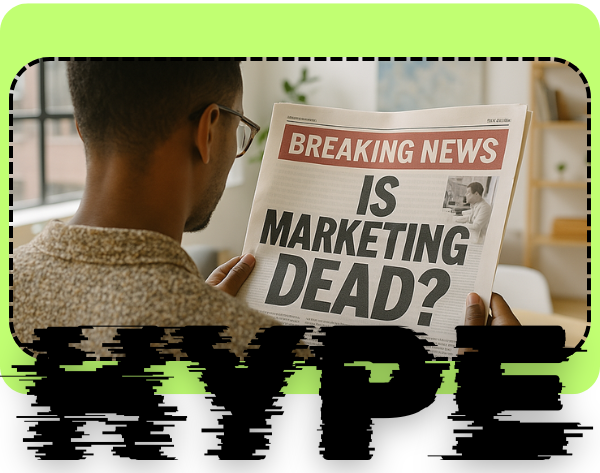
generated by ai
Marketers need more guts.
No, because we keep putting out trash.
We keep executing from the same playbook.
We keep stalking our competitors instead of our vision.
We keep losing sight of the goal with a constantly moving target and budget.
We’ve lost our edge.
And that’s not the reason we got into this business, is it?
So, congratulations, you did it.
You’ve cracked the code and managed to make marketing—a once electric, culture-shaping, boundary-pushing art form—so safe, so predictable that it’s basically a 90s workplace health & safety video.
We’re no longer the moment that makes people stop, think, and feel. No, we’re churning out content that’s algorithmically approved, editing committee certified, and passion-free.
If we’re not going off the rails with incongruent partnerships, it’s ai-generated productions now?! The brand narrative is starting to glitch.
no inclusivity, no challenging of stereotypes, just status quo
Whenever brands need a quick hit, they reach for the usual suspects.
Performance marketing: Celebrities with massive followings.
We’ve seen it with Snoop x Solo Stove, and instead of curating a lifestyle, they rent one that’s about as relatable as a White Lotus episode.
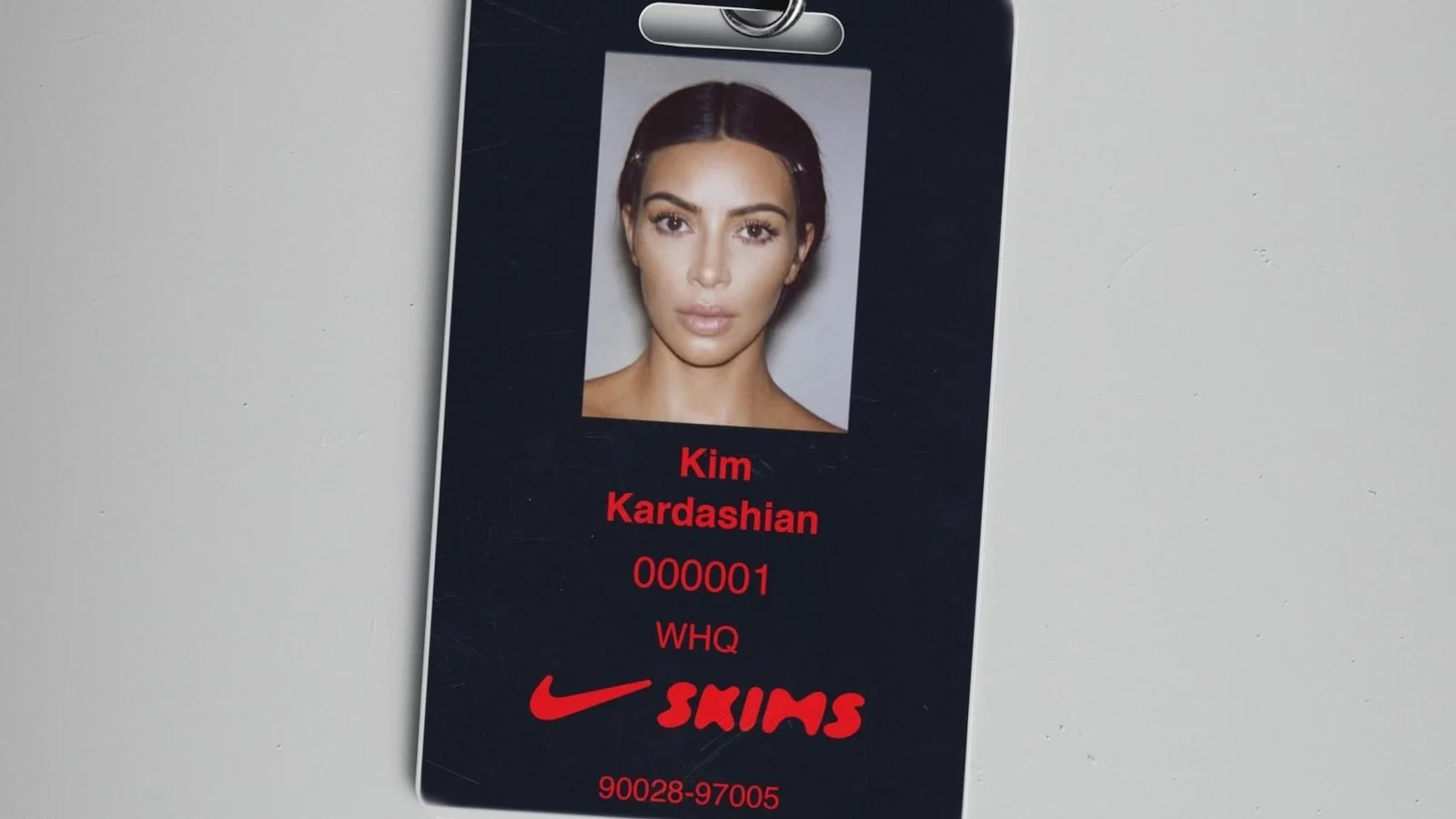
Exhibit A: Nike x Kim Kardashian
Athleticism is diluted into aesthetics.
A brand synonymous with athletic excellence teaming up with a celebrity whose brand is built on shaping beauty standards rather than breaking a sweat. A deal expected to significantly boost the value of Kim Kardashian's shapewear brand, SKIMS, which is already valued at $4 billion.
This isn’t about questioning Kim’s business acumen or Nike’s desire to expand their market share to 6.2% within 24 hours.
BFFR. Michael Jordan is an athlete, hardly the same Business Insider.
It’s about asking why we keep reaching for these predictable partnerships when there are countless other stories waiting to be told—stories that might not rack up likes as fast but could actually create cultural impact like a Kendrick Lamar. Cause we need it so bad right now!
Why not align with unconventional athletes who break the mold of what fitness looks like? Like Tatyana McFadden, a paralympic wheelchair racer and the closest we’re getting to a superhuman.
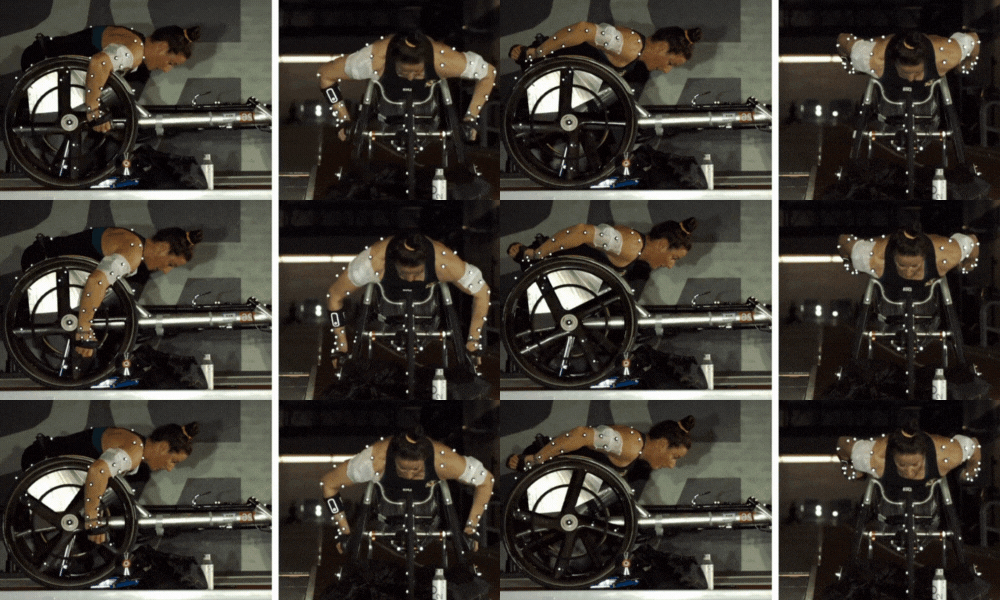
Why not invest in campaigns that tell the stories of women using sports to challenge societal norms? We see you, Sha’Carri Richardson, a track and field badass who knows her place—IT’S FIRST.
As Nike has done so before. Why are we losing the plot?
Of course, Kim’s influence is undeniable.
But this is not a shot at one thing.
It’s a firing round at the entire myopic machine. When you boil down marketing to only leveraging someone’s follower count, it becomes solely a transaction.
As I mentioned before, both entities are not short of cash.
This is not a creative brief of inspiration but for Instagrammability.
Marketing has become so dull.
a pandering partnership went sour…*shock-face emoji*
Exhibit A.1: Gymshark x TikTok Star Alix Earle Lawsuit
Alix Earle expressed support for Israel, posting "Now and always, we stand with the people of Israel" on Instagram. Gymshark caught wind of it and dropped the TikTok star faster than a tariff retaliation. Earle, feeling blindsided, filed a lawsuit, claiming the brand owed her $1 million for proposed promotional content, but the brand denied any formal contract ever existed. After some back-and-forth, they settled in court, but the details are hush-hush.
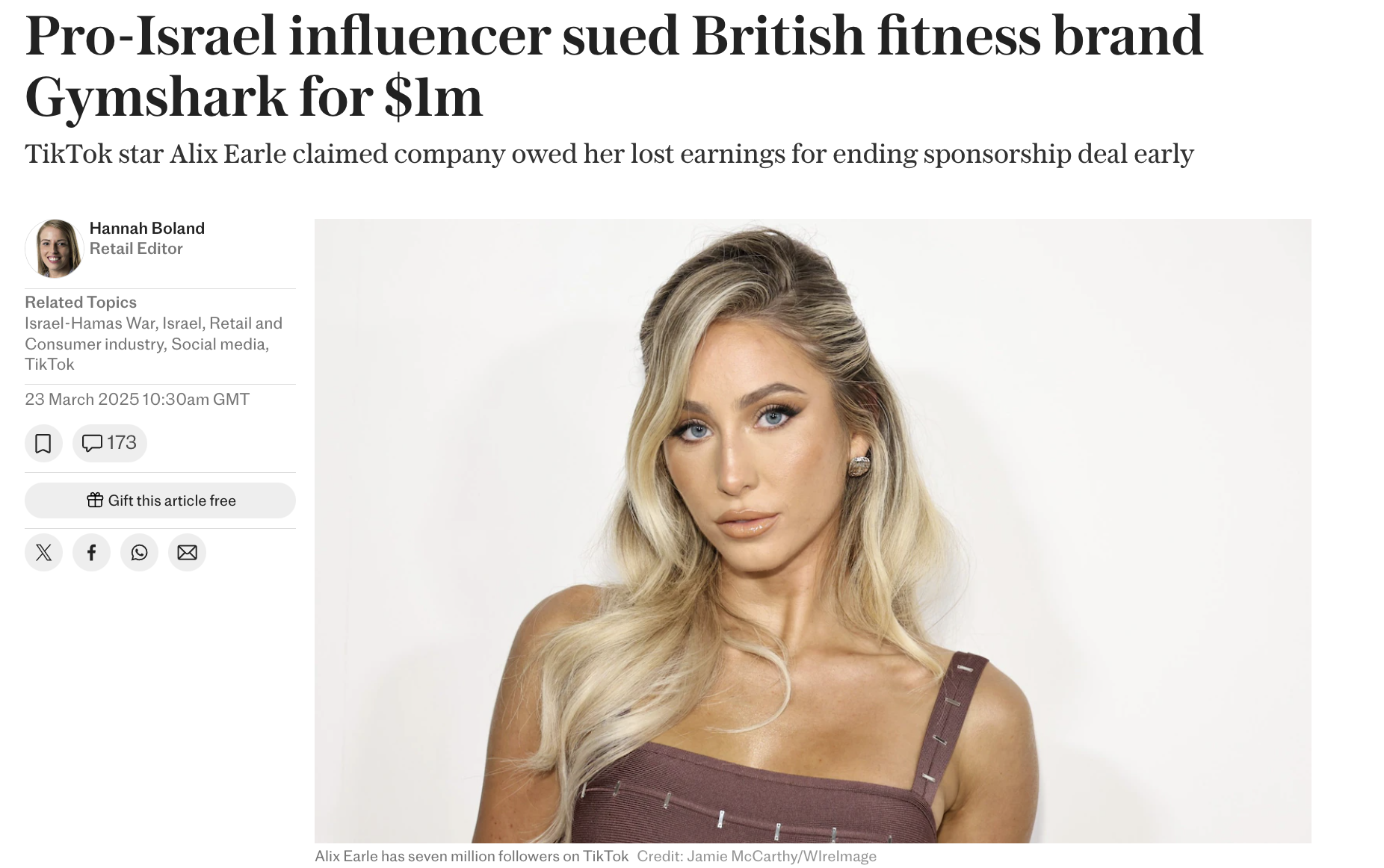
Earle’s over 11 million follower count overshadowed the hollow nature of the brand partnership. When brands know who they’re serving and why it matters, they can spot a misalignment from a mile away. The TikTok streets already knew about her previous racist indiscretions though!
Honestly, I’m impressed Gymshark stood on business and made the correction. But let this be a cautionary tale for brands in their influencer frenzy: Know who you’re partnering with—and more importantly, know why. Because sometimes, chasing clout can leave you catching lawsuits instead.
no heart, no humanity, just budget cuts
This brings me to our obnoxious obsession with ai.
Creativity has been outsourced and used as a crutch to avoid the messy, unpredictable work of creating something uncommon.
Exhibit B: Puma’s ai-generated ad
Puma decided to hand over the reins to the monotone machine—no human oversight, just a bunch of ai agents generating concepts, scripting, and visuals.

I hate it here.
This is an ad that technically checks all the boxes of “creativity” but lacks the heart and spontaneity of real human storytelling.
It’s efficient, sure. Novel, absolutely. But does it resonate? Hell nah.
The whole thing resembles a Bing search image gallery: copyrighted, formulaic, and ultimately soulless.
I think tf not
The campaign itself was more proof of ai’s technical prowess than an actual cultural moment. Puma isn’t generating a narrative here—they produced a spectacle. The type you gawk at and ask ‘Why?!’
Survey says: there’s a disconnect.
The problem isn’t ai itself. It’s how we’re using it. We’re treating it like an artist rather than the paint brush, leasing creativity rather than investing in it. ai can be an incredible assistant. Something that helps shape ideas, enhance visuals, or predict trends. But when it becomes the entire creative department, fcuk no!
We end up with this. Campaigns that feel manufactured rather than meaningful.
Giving up on the imperfect brilliance of human creativity because we’re too afraid of the unpredictable is a major cop out. The risk of creating something that doesn’t immediately rack up likes or approval feels too great, so instead let the mechanical machine take the fall.
Le sigh.
turns out, everybody cares about the use of ai…*melting face emoji*
Exhibit B.1: Fiverr x ai
What Fiverr was trying to get across was that ai is a powerful tool when paired with talented freelancers on their platform. The catchy musical number, complete with jazz hands and cameos—it was flashy, it was upbeat, and... it fell on deaf ears.
No shots fired at the ad itself—I actually kinda liked it. I even caught myself humming along at one point. But let’s focus here: the real issue is brand positioning. Just because something is creative doesn’t mean it aligns with how your audience views you. Get this wrong, and suddenly, your brand feels like it’s doing a tap dance to save revenue.
Fiverr isn’t exactly synonymous with high-quality content output, so doubling down and essentially saying you also don’t care was...questionable. The desperation of it all.
In a world already cautious of ai’s impact, people want brands to take a stance, not do a song and dance.
human experiences > expected narratives
Because if you’re playing it safe, you’re already losing.
Marketing is starting to feel more like a chore than an adventure. Where's the joy and experimentation?
Exhibit C: Pelle Windows x Missy Elliot “The rain (Supa Dupa Fly)”
Admittedly, I didn’t know anything about this brand or ad until Dr. Marcus Collins posted about it. And it’s what the industry is missing. It’s why I got into marketing in the first place. I mean, outside of becoming the Black Seth Godin to build a purple cow personal brand and never need to pitch myself again.
I got into marketing to tap into the cultural and emotional reverence of the human experience. To elevate the underrepresented and spotlight the underserved. People don’t buy the what—they buy the why.
That’s what was in the marketing syllabus.
And Pella Corporation's latest ad campaign, "Make Life Brighter," is an unexpected departure from traditional window and door marketing.
What is seen as a conventional and often boring industry. This ad was anything but. It wasn't a product ad. It's a connection point—emphasizing the emotional value. It highlighted your home as a place of protection and peace.
Pella released two versions of this ad: a short form and a longer video that’s two minutes (watch the full music video to get the full concept). It reels you into the moment they’ve intentionally cultivated. The campaign has also recently been recognized by Ad Age's Top 5 Creative Ads.
if you’re going to ai—ai with this secret recipe
Exhibit C.1: KFC x ai
By hosting a live taste test and letting consumers weigh in, KFC Canada proved that you just can’t beat the OG. They didn’t just throw ai at the problem and hope nobody could smell the stench of desperation for sales. They made it part of the joy and experiment. ai wasn’t the star of the show—it was the sidekick. The human touch came out on top, exemplifying how you innovate without sacrificing heritage. *chefs kiss*
high-like marketing—ready to risk it?
Marketers, the fear of backlash has killed our hunger for imagination.
The cost of being remarkable is discomfort. The cost of being comfortable is irrelevance.
So we need to get high-like off our own supply.
Nike was playing it safe by partnering with Kim Kardashian. Predictable. Who isn’t partnering with her?! Let’s brand causes, not personas.
And we’ve seen what happens when Puma leased their creativity to ai. Bland. Let’s scale depth, not shortcuts.
Meanwhile, a windows and door company, Pella Corporation. Dared to go against the matrix. And tapped into the heart of the matter: humanity. They saw their windows not as a product but as portals to a brighter life.
Marketers have the power to shift perspectives, shape culture, and disrupt hierarchies.
We should be brave.
If no one’s left to tell real stories, make bold statements, and let creativity bloom, the world loses its voice. High-like marketing isn’t about chasing easy approval. Aim higher and choose courage over the ever-so-played-out complacency.
History needs meaning. And marketers are the right ones to revive it.
Signed,
A marketer making sense of the nonsense online
👋🏾 Soooo…collective illusion is public enemy number one—Don’t Believe The Hype. Every so often, we’ll say the quiet parts out loud (in your inbox). So we can cancel or co-sign marketing or market trends and discern pop culture gems from flops together. And start making sense of the nonsense online.

Fresh-Like: Why I'm decentering work after losing my sister
And I finally got the memo: work will never grieve you.

I never want to force myself to write for this blog just to hit some arbitrary deadline. If I’m hitting publish, it’s because something needs to be dragged out of my brain and into the light.
There are a million things I could write about, but choosing the ones actually worth my time (and yours) is the tricky part.
That said, if you ever spot a hidden gem or flaming flop in some deranged social experiment disguised as marketing, drop me a line. I love a good deep dive.
Anyway. I fought hard not to write this post because death is inconvenient, sad and forced memories that you know you can never recreate because that person is gone. When my sister passed (1 year-2 months-3 weeks and 2 days ago), it was like my entire nervous system short-circuited. People say their world stops. And I used to call bullshit, but that is the best way to describe it.
I screamed. I cried. Until my face was unrecognizable from the swelling under my eyes. I’ve had migraines before, but this one lasted for weeks.
She died on the job.
She was an overcommitted Personal Support Worker. The go-to person. The one who showed up for everyone—inside and outside of work. And yet, the day she passed, it was business as usual.
I didn’t know after a series of events, it would lead me to this.
I stumbled across a TikTok (because of course I did), and it was talking about decentering work. And suddenly, it clicked. I finally had the language for something I’d been feeling and doing for a while.
Fresh-like approach
This is exactly why I started this Substack—because work was swallowing my life whole. And even though I like to work, I also need to get back to what lights me up.
Writing.
Not for a magazine byline or brand guest post but for me.
Because job titles were becaming my entire identity, and the last time I let that happen, I spiralled. It’s why you won’t catch me doing those “Thrilled to join *company*!” posts on LinkedIn anymore. I get that the whole purpose of the briefcase app is to publicly pledge allegiance to your employer, but… doesn’t anyone else find it a little weird?
I mean—the economy is shifting like a glitchy Sims world. Workplace rules are chaotic. Orgs are being restructured every quarter, if not more. The idea of staying with one company for a decade is something our parents did. We won’t.
So, where does that leave us?
How we view expertise is no longer about tenure—it’s about track record: Competence. Presence. Impact.
Professionalism has nothing to do with how you look—it’s how you deliver.
Hella Perspective: The Wicked redefinition of professionalism →
Can you show ROI? Leverage synergies? Run it up the flagpole? Boil the ocean? Or translate corporate Duolingo?
NONE of that has anything to do with the other half of your life. And YET, for some of us—myself included—it gets lost in the blur of our professional selves.
Maybe it’s time to step back.
Not to disengage—but to reclaim the parts of ourselves that don’t come with a paycheck.
So I’m on that discovery.
Who am I without the role, the title, or the company logo stamped behind my name?
If I’m not “Senior Insert Impressive Title Here at Respected Company™,” then what’s left? What do I actually enjoy outside of productivity hacks and industry insights? Am I still ambitious if my ambition isn’t tied to a job description?
I don’t have all the answers yet. But what I do know is this: I refuse to have my headstone read business as usual.
And before you ask, decentering work isn’t about doing less—it’s about making sure work isn’t the only interesting thing about you.
So, what’s the less morbid alternative?
Prioritizing Autonomy
I didn’t stumble into my marketing career—I strategically stacked my skills.
Three credentials deep in social service, IT, and marketing, I was making all kinds of zigzag moves that didn’t make a lick of sense at the time. But breaking into tech did. It felt like getting into an exclusive sorority—one where the title, the paycheck, and the respect were the ultimate flex. I had something to prove.
But then, the same company that once gave me that warm, fuzzy sense of belonging decided it didn’t need me anymore. Laid off. And let me tell you, the first time was crippling. The second time? Infuriating because trailing behind it was my sister’s funeral.
And I finally got the memo: work will never grieve you.
It’s then I realized I didn’t just want a seat at the table—I wanted the ability to walk away from it if it no longer served me. Autonomy over attachment. That’s the goal now.
Bigger Than the Title
At first, success meant getting in the room. Getting the title. Getting the paycheck. I measured my worth in corporate acceptance letters like Ivy League admissions.
But when that job got pulled from under me, it forced me to ask: What was I really building?
If I had to start over from scratch every time, then clearly, I wasn’t playing big enough. That layoff didn’t end me—it recalibrated me.
Redirecting your building efforts into something that can catch you when you fall is a skill set they don’t teach in school. Being unfirable is not about gripping your PTO tightly. It’s about building a network that opens doors.
A foundation so strong that even if a job disappears, your value doesn’t.
Work Can’t Be the Main Character
I wouldn’t change a thing about my career journey.
Not the struggle, not the heartbreak, not the frustration. Because every time I lost a job, I found myself. Now, I don’t let work consume me—I let it support me. The difference is I put ME as the priority. And ME will always have my back.
Decenter work by making sure you’re the one in control of your autonomy, purpose, and life.
And because old habits are hard to break, I’ve done what any recovering taskmaster would—I’ve established a set of guiding principles to keep me accountable.
I invite you to explore what decentering work looks like for you, too. Maybe it’s setting firmer boundaries, reclaiming your time, or not announcing your next role on LinkedIn. And if you have a better way to do it—or a hobby recommendation that doesn’t involve running at 6AM—drop me a line. I’m all ears.
The Decentered Work Credo
I am not my job.
I am more than a title, a salary, or a performance review.
Work supports my life—it does not define it.
At my best, I give my energy to what matters.
I commit to excellence, but I reject burnout as a badge of honor.
Overwork is not a virtue—it is a failure of boundaries.
I choose autonomy.
I build options not just for financial freedom but for leverage.
A paycheck is not my safety net.
My skills, my adaptability, my network—that is my foundation.
I embrace seasons.
Some years are for acceleration. Some are for stillness.
There is strength in knowing when to push forward and when to step back.
Not every year needs to be a hustle year.
I measure milestones beyond work.
I refuse to let my greatest accomplishment be how much PTO saved.
The best moments in life are not tracked in KPIs.
They are found in experiences, in relationships, in personal growth.
I work hard. But I work smarter.
I build. I grow. I live.
And in doing so, I choose ME.
👋🏾 Soooo…collective illusion is public enemy number one—Don’t Believe The Hype. Every so often, we’ll say the quiet parts out loud (in your inbox). So we can cancel or co-sign marketing or market trends and discern pop culture gems from flops together. And start making sense of the nonsense online.

Backwards-Like: The silent class war behind DEI rollbacks & the rise of personal branding
There is no innovation in stagnation.

It’s not about priorities. It’s about power.
The rollback of DEI isn’t a step backward—it’s a correction to keep class structures intact.
I told myself I wasn’t going to write about DEI again. Lord knows the internet doesn’t need another think piece. It’s the same conversation on loop, usually led by Black and Brown folks. But there’s an angle being overlooked—one that makes the whole DEI debate a little more logical. And that it’s never been just about race.
Classism has been the main character all along.
Too many “non-traditional” hires found a way in, and now the corporate world is hitting the reset button.
But they forgot to close the back door.
While companies pull back DEI, the rise of personal branding: LinkedIn thought leadership, TikTok entrepreneurs, and Twitter commentators are building influence without permission. And it’s giving individuals a way to bypass traditional gatekeepers and build influence on their own terms.
And that, my friends, is what corporations really fear: not the increase of diversity, but the lack of control.
Mini caption for the sister of woke
DEI: Diversity, Equity and Inclusion.
A wise LinkedIn commentator once said we should start writing it out because when you shrink DEI into an acronym, you shrink its meaning too. And honestly…points were made.
If you’re against Diversity, Equity, and Inclusion, then what you’re really advocating for is fake meritocracy—a system propped up by bias, discrimination, lawsuits, attrition, groupthink, and, let’s be real, mediocrity.
The part where it’s backwards-like: class loyalty vs. class mobility

We’re living in two work realities at the same time, and somehow, we’re supposed to be great at both.
On one hand, there’s the Industrial Era Thinking (Class Loyalty): work hard, be grateful, keep your head down, and maybe—maybe—you’ll climb the corporate ladder.
On the other hand, we’ve got the Tech/Digital Era Thinking (Class Mobility): work smart, build a personal brand, and make your own lane because corporate loyalty won’t pay the bills.
The problem? Companies expect us to juggle both.
But let’s put this into context. The days of working on the assembly line for 40 years and retiring with a pension are gone. Social mobility used to be tied to inheritance (family farms, generational businesses), and then education became the new currency. The most valued career paths—professional and technical jobs, entrepreneurship—require an advanced degree, capital, or both.
Over the years, gatekeepers have made sure not everyone gets access, and the price of entry kept rising.
This is why DEI wasn’t just about diversity—it was about who gets access to capital, opportunity, and power. Historically, wealth was tied to financial capital (land, money), but in today’s landscape, human and social capital determine who moves up. And guess what personal branding does? Did you guess it?? It bypasses the traditional power structures and creates new paths for influence. That’s why it’s on the rise.
So now it’s less about nepotism and elite pedigrees. The average person is getting a shot now because of skill.
And although DEI was supposed to be the bridge between these two worlds, giving marginalized folks a fair shot at the same corporate perks that had always been reserved for the right kind of professionals (read: the ones who already fit in). Companies got to look progressive, hire a few “culture adds,” feature a few minority-owned brands and pat themselves on the back for “opening doors.”
But now that too many outsiders have made it inside—the door is being slammed shut with the quickness.
Follow-up point of backwards-like behaviour: self-made vs. skill-made success
Skill—not pedigree—is producing our next wave of CEOs, founders, and millionaires.
And honestly…the old guard is stressed about it. For decades, success was gatekept behind Ivy League degrees, country club connections, and last names that sounded like they owned a railroad. But now. The real currency is skills. And according to McKinsey, those skills have the lifespan of an iPhone update—half of them are irrelevant in five years (whispers in AI).
And let’s be real—education systems are crumbling under the weight of their own irrelevance. Schools can’t keep pace with online learning, and the proof is in who’s winning: experience and skill are outpacing advanced degrees every time. 28% of high school graduates out-earned the median associate’s degree holder, and 37% of associate’s degree holders outearned the median bachelor’s degree holder—all because they learned skills through experience rather than traditional education.
That’s why people from lower-income backgrounds are finding new pathways to wealth—the gatekeepers are still holding clipboards at the front door while folks are building whole empires through YouTube, TikTok, and AI-powered businesses. Like my daughter, who’s getting a middle school education by day and running a YouTube empire by night. Which one is more important? Yes, both. One gets you through the gatekeepers, and the other makes sure you don’t need their approval ever again.
It’s the same for companies. The longer you stay at one place, the more outdated your skills become. Workers who take on higher-skill distance jobs (also known as “job-hopping” to roles requiring 30-40% new skills) are the ones climbing income brackets, while those who stay in familiar roles see little to no financial progression.
But instead of training employees to keep up and stay put, companies clutch their pearls, worried that talent will take what they’ve learned and leave.
News. Flash.

That’s already happening. Either people jump ships, or they stay and sink the ship.
There is no innovation in stagnation.
And in a world where experience is the real golden ticket, companies refusing to evolve are about to find themselves on the wrong side of the wealth gap.
And isn’t this what the people want?!
We are in the Age of Aquarius—where technology reigns, and the power belongs to the people. It’s written in the stars. So while some see the rollback of DEI as a reverse Uno of progress, the powers that be are about to learn what else is backwards-like.
Don’t believe the hype—because the real power shift. It’s not happening in boardrooms.
Just scroll online.
Build the skills that don’t expire in 5 years but compound instead. Start here ⬇️
Professionalism has nothing to do with how you look—it’s how you deliver.
Hella Perspective: The Wicked redefinition of professionalism →
In conclusion, The Corporate Classism Rewards Program
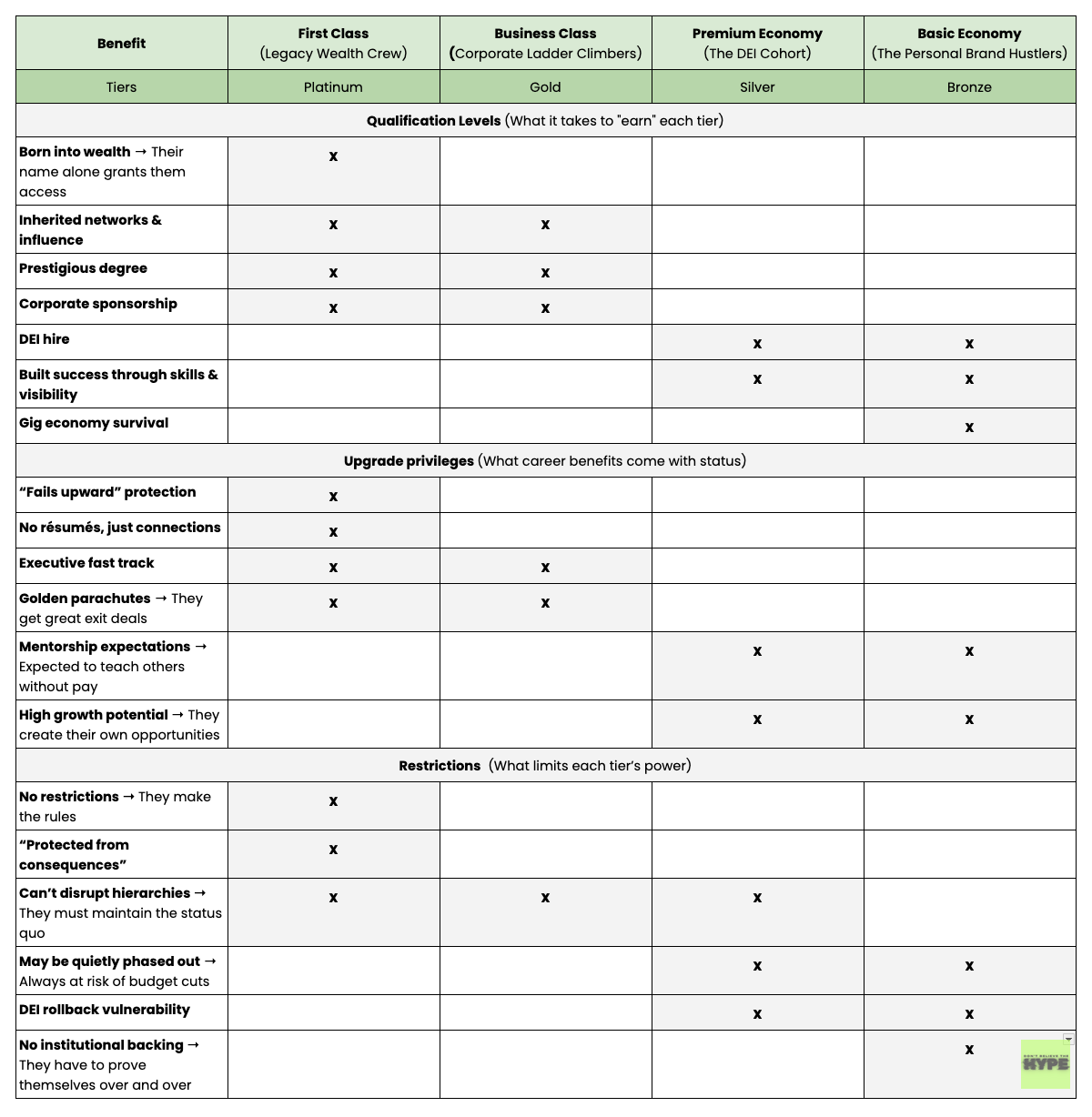
👋🏾 Soooo…collective illusion is public enemy number one—Don’t Believe The Hype. Bi-weekly, we’ll say the quiet parts out loud (in your inbox). So we can cancel or co-sign marketing or market trends and discern pop culture gems from flops together. And start making sense of the nonsense online.

Familiar-Like: An Executive Order, Your first 90 days on the job are a power play
You were chosen, so stop acting like you need permission to belong.
[ short answer ]
How do you make a strong impression in your first 90 days at a new job?
Treat your first 90 days as a three-month plan. Month 1: act like you belong, audit what's broken, and ask targeted questions about bottlenecks. Month 2: join existing projects and solve the problems you found. Month 3: set up your own workflows, automate repetitive work and build a process. Listen more than you talk, and don't fill everyone's calendar with intro meetings.
It’s a rare and beautiful thing when a manager actually does their homework before hiring you.
Because let’s be real, half of them are out here playing a guessing game with job descriptions they copy-pasted from LinkedIn.
But I’ll never forget the time a hiring manager really understood my brand & customer marketing expertise well before I even stepped into the first interview. She didn’t just skim my resume—she came prepared with receipts.
This woman asked me about the chatbot on my website and told me she wanted me to implement it at the company! A hiring manager who actually researched my work? I almost cried.
That kind of recognition will have you walking into a new job feeling like Beyoncé on her Homecoming tour—respected, ready, and already in formation.
That request will always make me feel warm and fuzzy inside.
Because of that, I hit the ground running on day one. No second-guessing, nor was I sidelined. No need to prove myself. I was trusted as a decision-maker, given the autonomy to actually do the job they hired me for, and empowered to lead with confidence instead of survival mode.
That kind of endorsement makes you want to give more because you’re not spending half your energy convincing people you belong.
But let’s keep it real…this kind of support is not standard.
For women entering the workforce, it’s still the exception, not the norm. And for Black women? It’s like spotting a pink unicorn—magical, mythical, and nowhere near as common as it should be.
And for that reason, I created this executive order.
Whether you have that level of support or not, you can make a power play in the first 90 days. Heck, you can start over even if it’s your 90th week on the job. Because waiting for someone else to advocate for you…that’s a gamble you don’t have time to take.
BY ORDER OF THE NEW HIRE POWER PLAY DEPARTMENT:
This executive order is a decisive action—no debate, no committees, no waiting around for approval.
It’s how leaders walk into the room, make their presence known, and start moving things in their favor from day one. Some have used it to bulldoze their way into power, signing off on decisions like they were flipping through a restaurant menu (we all remember that first week in office.) But in your case, it’s about stepping into your new role with authority—not hesitation.
Now, before we get into the details, let’s address the obvious: a lot has been happening. The year of January alone had enough plot twists to make a full-season recap necessary. So, after taking a moment to process all of that, it’s time to focus.
The first 90 days of a new job are your personal administration’s transition period. Move with intention, operate with clarity, and establish your reputation before someone else defines it for you.
Failure to comply may result in unnecessary meetings, performance anxiety, and coworkers forgetting you exist until month four.
MONTH 1: YOU WERE HIRED FOR A REASON—ACT FAMILIAR-LIKE
Directive 1A: You did not stumble into this job by accident. DO NOT underplay your skills. You were chosen, so stop acting like you need permission to belong.
Conduct an audit like a consultant: What’s broken? What’s slowing the team down? Where can you help immediately?
Accept all the meetings. Even invite yourself to ones (that seem relevant) —cross-functional included. However, avoid spamming your coworker’s calendar with meaningless 1:1s just to “introduce yourself” or coffee chats. Not only is it not a good use of your time (initially), but nobody likes unnecessary meetings when they’re at capacity.
Instead, ask targeted questions: What’s the biggest bottleneck? What’s taking longer than it should? What’s not working as well as it could? This is how you establish yourself familiar-like—as someone who listens, learns, and solves.
These are your golden tickets to scoring quick wins.
MONTH 2: THE SIDELINES ARE A TRAP—GET INVOLVED FAMILIAR-LIKE
Directive 2A: Watching from the sidelines is a one-way ticket to irrelevance. Get involved quick.
Get involved with existing projects early. Offer to help on projects where your skills apply, but be strategic—this is about contributing, not overcommitting. Every company wants you to learn its values, mission and culture by reading the documentation. But you learn faster by jumping in and working with the team.
Read the onboarding materials (yes, all of them) so you don’t waste time asking questions that already have answers or stepping on anyone’s toes. But also, don’t be timid about diving in simultaneously.
Be the solution to existing issues. Whether that’s setting up a process to make it easier to do something, recording the action items from a meeting to re-share or stepping in to fill a role if they’re short a person. *You would have discovered the existing issues by doing the audit in month one.
The faster you contribute, the faster you become familiar-like with the real work culture—not just the handbook version.
📌 NOTE: If you are waiting for someone to personally guide you into productivity, prepare to be disappointed. Self-starting is the real onboarding.
MONTH 3: AUTOMATE, ORGANIZE, AND WORK SMARTER—FAMILIAR-LIKE A PRO
Directive 3A: Chaos is inevitable, but preparedness is optional.
Set up your own workflows early. Organize your tasks in a way that makes sense for you.
Automate redundant work. Not to take on more, but to protect your mental bandwidth on days when you don’t want to think—just do.
Have a process. Working smarter is how you maintain your energy (not your time). A process in place allows you to put more emphasis on the strategy rather than the execution. The sharper the sword, the cleaner the cut.
⚠️ VIOLATION PENALTY: Failure to automate may result in burnout, unnecessary overtime, and wondering why this job suddenly feels way harder than it should.
FINAL RULING:
Getting up to speed is your job—nobody’s handing you a syllabus.
Your fresh perspective is only valuable if it’s backed by actual understanding. If you don’t have enough context yet, don’t be out here scheduling 1:1s just to ask, "So, what do you do?" That’s LinkedIn small talk, not strategy.
The goal isn’t to be the new hire everyone remembers because you booked half their calendar—it’s to be the one they respect because you ask smart questions and move with intention. Don’t come in thirsty to prove yourself (gives off pick-me energy). Instead, be active where it counts: drop insightful questions in meetings or Slack (“Where are the biggest opportunities for improvement?” “What’s a total time-suck we should fix?”).
Listen more than you talk. That’s how you figure out what actually matters.
Once, a manager mandated I set up 1:1s with everyone during a campaign launch. Imagine squeezing yourself into someone’s already overbooked calendar just to say hi—when they’re trying to meet a deadline?! Be so for real.
To successfully familiar-like your first 90 days, you must:
Pay attention, then conduct an audit.
Get involved early.
Establish your process and presence.
*Also, I am dropping this post here once you’ve settled into your new role and realize it’s a hot mess like every other company you’ve been in.
Thirsty as F*ck: Was 2020 the best year for human capital? →
OFFICIAL SEAL OF APPROVAL: If followed correctly, these directives will result in a seamless, confident, and respected presence at your new job. If ignored, prepare for a long, awkward onboarding period where people constantly ask, “Oh, are you new here?”…although it might buy you some grace (and plausible deniability) when you inevitably fumble a few things in your first 90 days.
“Who knew it could be this complicated?”
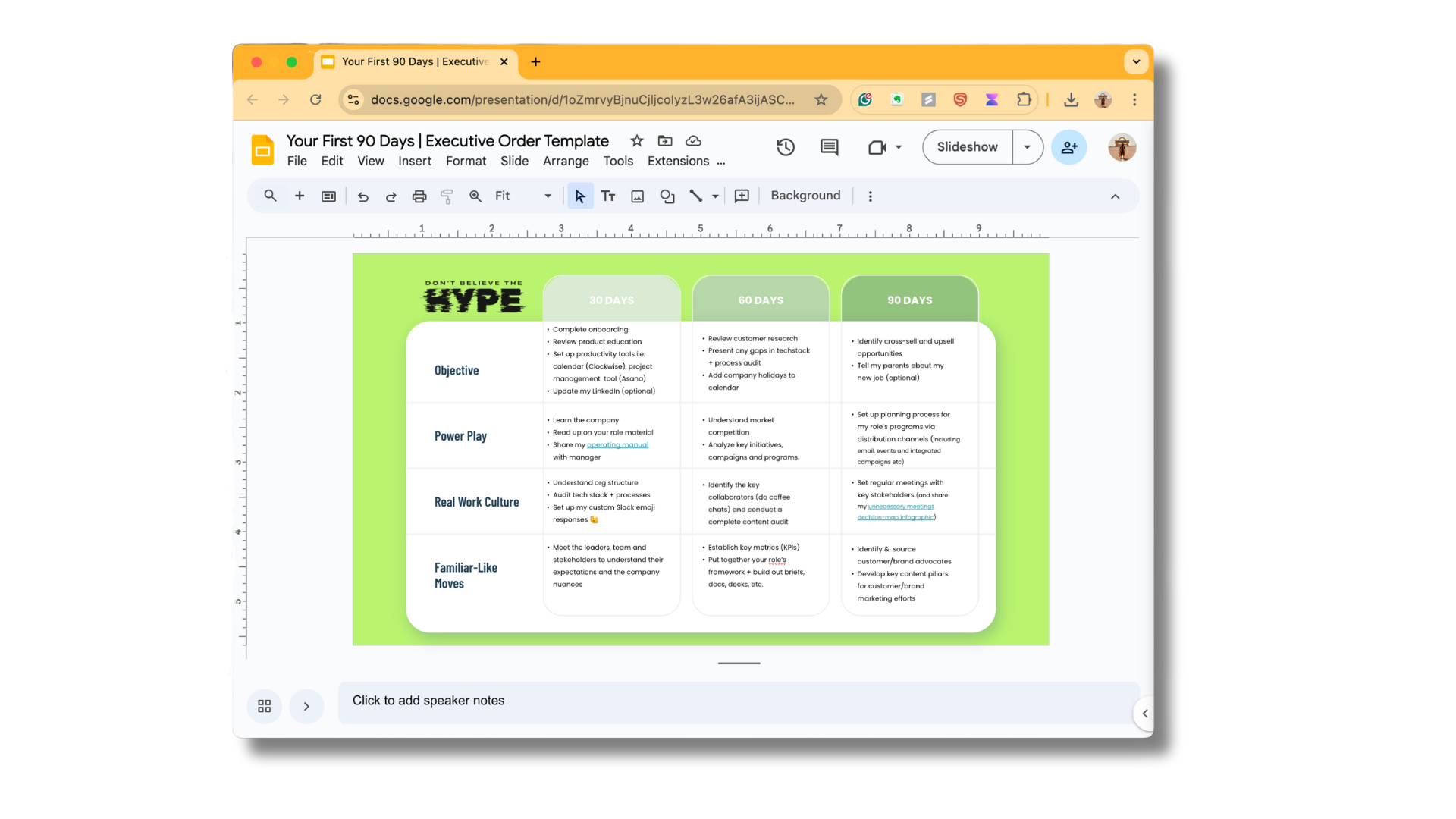
Need a 90-day template? Here’s mine. File. Make a copy.
👋🏾 Soooo…collective illusion is public enemy number one—Don’t Believe The Hype. Bi-weekly, we’ll say the quiet parts out loud (in your inbox). So we can cancel or co-sign marketing or market trends and discern pop culture gems from flops together. And start making sense of the nonsense online.