
Backwards-Like: The silent class war behind DEI rollbacks & the rise of personal branding

It’s not about priorities. It’s about power.
The rollback of DEI isn’t a step backward—it’s a correction to keep class structures intact.
I told myself I wasn’t going to write about DEI again. Lord knows the internet doesn’t need another think piece. It’s the same conversation on loop, usually led by Black and Brown folks. But there’s an angle being overlooked—one that makes the whole DEI debate a little more logical. And that it’s never been just about race.
Classism has been the main character all along.
Too many “non-traditional” hires found a way in, and now the corporate world is hitting the reset button.
But they forgot to close the back door.
While companies pull back DEI, the rise of personal branding: LinkedIn thought leadership, TikTok entrepreneurs, and Twitter commentators are building influence without permission. And it’s giving individuals a way to bypass traditional gatekeepers and build influence on their own terms.
And that, my friends, is what corporations really fear: not the increase of diversity, but the lack of control.
Mini caption for the sister of woke
DEI: Diversity, Equity and Inclusion.
A wise LinkedIn commentator once said we should start writing it out because when you shrink DEI into an acronym, you shrink its meaning too. And honestly…points were made.
If you’re against Diversity, Equity, and Inclusion, then what you’re really advocating for is fake meritocracy—a system propped up by bias, discrimination, lawsuits, attrition, groupthink, and, let’s be real, mediocrity.
The part where it’s backwards-like: class loyalty vs. class mobility

We’re living in two work realities at the same time, and somehow, we’re supposed to be great at both.
On one hand, there’s the Industrial Era Thinking (Class Loyalty): work hard, be grateful, keep your head down, and maybe—maybe—you’ll climb the corporate ladder.
On the other hand, we’ve got the Tech/Digital Era Thinking (Class Mobility): work smart, build a personal brand, and make your own lane because corporate loyalty won’t pay the bills.
The problem? Companies expect us to juggle both.
But let’s put this into context. The days of working on the assembly line for 40 years and retiring with a pension are gone. Social mobility used to be tied to inheritance (family farms, generational businesses), and then education became the new currency. The most valued career paths—professional and technical jobs, entrepreneurship—require an advanced degree, capital, or both.
Over the years, gatekeepers have made sure not everyone gets access, and the price of entry kept rising.
This is why DEI wasn’t just about diversity—it was about who gets access to capital, opportunity, and power. Historically, wealth was tied to financial capital (land, money), but in today’s landscape, human and social capital determine who moves up. And guess what personal branding does? Did you guess it?? It bypasses the traditional power structures and creates new paths for influence. That’s why it’s on the rise.
So now it’s less about nepotism and elite pedigrees. The average person is getting a shot now because of skill.
And although DEI was supposed to be the bridge between these two worlds, giving marginalized folks a fair shot at the same corporate perks that had always been reserved for the right kind of professionals (read: the ones who already fit in). Companies got to look progressive, hire a few “culture adds,” feature a few minority-owned brands and pat themselves on the back for “opening doors.”
But now that too many outsiders have made it inside—the door is being slammed shut with the quickness.
Follow-up point of backwards-like behaviour: self-made vs. skill-made success
Skill—not pedigree—is producing our next wave of CEOs, founders, and millionaires.
And honestly…the old guard is stressed about it. For decades, success was gatekept behind Ivy League degrees, country club connections, and last names that sounded like they owned a railroad. But now. The real currency is skills. And according to McKinsey, those skills have the lifespan of an iPhone update—half of them are irrelevant in five years (whispers in AI).
And let’s be real—education systems are crumbling under the weight of their own irrelevance. Schools can’t keep pace with online learning, and the proof is in who’s winning: experience and skill are outpacing advanced degrees every time. 28% of high school graduates out-earned the median associate’s degree holder, and 37% of associate’s degree holders outearned the median bachelor’s degree holder—all because they learned skills through experience rather than traditional education.
That’s why people from lower-income backgrounds are finding new pathways to wealth—the gatekeepers are still holding clipboards at the front door while folks are building whole empires through YouTube, TikTok, and AI-powered businesses. Like my daughter, who’s getting a middle school education by day and running a YouTube empire by night. Which one is more important? Yes, both. One gets you through the gatekeepers, and the other makes sure you don’t need their approval ever again.
It’s the same for companies. The longer you stay at one place, the more outdated your skills become. Workers who take on higher-skill distance jobs (also known as “job-hopping” to roles requiring 30-40% new skills) are the ones climbing income brackets, while those who stay in familiar roles see little to no financial progression.
But instead of training employees to keep up and stay put, companies clutch their pearls, worried that talent will take what they’ve learned and leave.
News. Flash.

That’s already happening. Either people jump ships, or they stay and sink the ship.
There is no innovation in stagnation.
And in a world where experience is the real golden ticket, companies refusing to evolve are about to find themselves on the wrong side of the wealth gap.
And isn’t this what the people want?!
We are in the Age of Aquarius—where technology reigns, and the power belongs to the people. It’s written in the stars. So while some see the rollback of DEI as a reverse Uno of progress, the powers that be are about to learn what else is backwards-like.
Don’t believe the hype—because the real power shift. It’s not happening in boardrooms.
Just scroll online.
Build the skills that don’t expire in 5 years but compound instead. Start here ⬇️
Professionalism has nothing to do with how you look—it’s how you deliver.
Hella Perspective: The Wicked redefinition of professionalism →
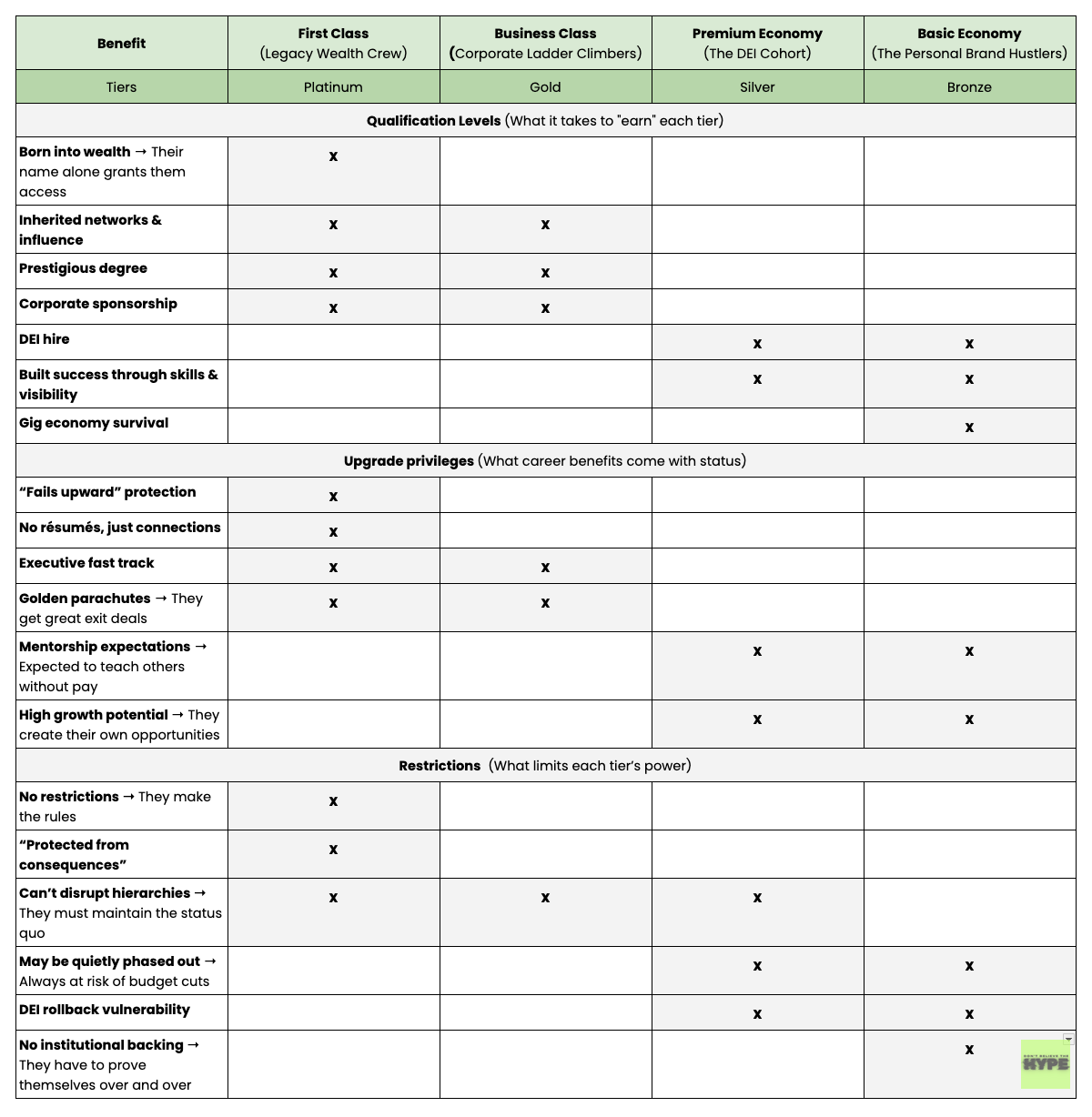
In conclusion, The Corporate Classism Rewards Program
👋🏾 Soooo…collective illusion is public enemy number one—Don’t Believe The Hype. Bi-weekly, we’ll say the quiet parts out loud (in your inbox). So we can cancel or co-sign marketing or market trends and discern pop culture gems from flops together. And start making sense of the nonsense online.