

How To Sniff Out Bad Apple Clients, An Untold Tale
I have a cautionary tale to tell. Pull up your favorite bean bag and a non-disclosure agreement.
[ short answer ]
What are the warning signs of a bad client?
Watch for four red flags. They won't fill out your intake questionnaire. They keep trying to haggle over your price list. They ask endless questions about return on investment and expect you to fix everything overnight. And they fight every recommendation you make. If someone won't do a five-minute questionnaire, expect them to fight your whole process.

Once upon a time...
The story of Snow White a classic tale of naivety.
She bit into a poisonous apple handed to her by one of the wickedest of witches. In hopes of stealing her beauty and sending her into a deep slumber never to awaken.
Which meant death.
Well, this is not the story I'll be sharing with you...
Instead, I'm here to tell the tale of what would've happened if Snow White knew the phrase "stranger danger" and went off on her merry way to pick flowers or whatever.
I wish someone would've hipped me to these "sniffing out sour apple techniques" and identify potential nightmares in the making. In turn, avoiding the slow death of our soul --saving the heartache and future bags under your eyes.
When you sniff out these 4 bad apple clients, don't take the bait.
Learn from Snow White. And stay woke.
1) They Won't Take The Test
If you have a system in place to qualify a client like a mini questionnaire, or survey etc and they avoid doing it.
I smell something sour from this apple.
Having a process or steps in place before you hop on a call, helps you determine if you or they are a right fit without wasting anyone's time. If your intake process determines they're not emotionally or financially prepared to solicit your service, or they're asking for a project above your expertise. You can politely send them an email declining their acceptance and redirecting them somewhere else with a better fit.
Trust me on this.
If they refuse to answer a 5 min questionnaire, they'll most likely, fight your entire process.
And what's a business, without a process and systems?
The answer, a hobby.
2) They Won't Stop "But, what if..."-ing Your Price List
Having a price list is the most professional thing you can do for your business.
Even Burger King has one.
- It shows you've put thought into the details of every project.
- It shows you know what your ideal clients generally ask for.
- It's also a tell tale sign you have a system in place for generating results.
Then here comes a potential client "But, what if we didn't do this or take out this. Would it still be the same price?"
Is there a worm I see in this apple?
They wouldn't negotiate paying $1.00 instead of $3.99 for their burger. They would just decide if they wanted cheese, bacon or both on it. If they're not going to battle with Burger King's menu, the same applies to your price list.
Go ahead and be generous: Add perks to the project like unlimited emailing throughout the working relationship or an additional thing-a-ma-jig but the price list is the price list.
Just be open to including fries with that.
💡 related: How To Tell If Your Prices Are Way Too Low
3) They Ask a Ton of ROI Questions
Of course, you want to get a return on your investment. Duh.
It's the part where they put all the responsibility on YOU producing exceptional results overnight. They came in with a mess, expecting you to clean it up and someone to point the finger at, just because they were burned in the past.
This apple looks bruised.
This is where you tell them, "We're not a good fit" and recommend therapy instead.
4) They Battle Every Gawddamn Suggestion
This one truly baffles me.
They pay you (the expert) to get the job done...then tell you, they want to try it their way first.
Why am I here?!
Am I being punked?
Baffled.
These are one of those GMO apples.
Here's where you take the reigns and remind them why they hired you in the first place. If they could have done it themselves, they would have rolled up their sleeves and took 40 days and 40 nights to get it right. What would've only taken you minutes.
Never undervalue your skills or allow the client to dictate terms.
Answer their questions, show your skillful savviness but also reassure them --they're in expert hands. And here to awaken them, from what could have been, an eternal slumber.
How do you sniff out bad apple clients?

A Double Dare to Hold Your Customer's Attention Hostage by Personalizing These 5 Generic Things on Your Website
Listen, the research has spoken 74% of customers feel frustrated when website content is not personalized. If you've been doing generic this whole time, what could that mean for your business? Down for a dare?

DEATH TO STOCK
Now, why would you want to hold your customer's attention hostage?
Well, for one, if they're on your website longer...there's more mischief and rabbit holes they can slide into. As they get to know your business more and more the deeper they'll go on your website. One thing could lead to another and they may even purchase something. Just a likely hypothesis.
Here's another (technical) reason...bear with me.
These Search Engines use "spiders" to crawl your website (i.e. Google, Yahoo, Ask Jeeves). This type of optimization process makes it easier for these Search Engines to index your website's content. Let's put it this way --if Google can index your website easier it helps achieve better ranking results. Better results equal more targeted traffic and more targeted traffic equals more hot leads.
Listen, the research has spoken 74% of customers feel frustrated when website content is not personalized (Source: Infosys, 2016) If you've been doing generic this whole time, what could that mean for your business?
💡 related: 5 Sneaky Ways To Write Using Your Ideal Client's Words
Lucky for you, these 5 things are a simple fix and you might even have fun doing it. No promises, that's why I double dared you.
1. Your Flat Navigation Menu
Long gone are the days you keep your website navigation menu basic.
- Home
- About
- Blog
- Contact
It was never great advice and it also grouped you into the rest of everyone else online. PopSockets does a cool job of effectively naming the essentials.
If you're photographer your navigation menu can look like this. (Keeping with the generic format above I added a twist connected to what you do.)
Meet <your name> Photo Lab Editing Lab Shoot Me
Think about it, your potential customers are there to find out how well you do your thing and if you can get them results. Cut to the chase.
Let's try another one, this time as a Graphic Designer.
Hi Inspiration Rough Draft Hire Me
Last one, from the menu alone --guess this industry.
Meet an Agent Buy/Sell New Listings List It
If you guessed Real Estate, you're smart.
As long as you use terminology your ideal customers are familiar with and identify where that click will take them, you can have fun with your navigation. Plus, menus are SEO friendly (meaning you can rank for those keywords in Google)...if that matters to you.
My navigation menu is centered around a Superhero theme (what my clients are AFTER they've worked with me). It's unrelated to what I do but I can get away with it, as it showcases my creative writing power. Think about how you can showcase what you do by how you navigate your customers through your website.
💡 related: CONVERSION VOODOO (WEBSITE AUDIT)
2. Your Stale Contact Form
Contact forms are the most underrated tool on your website but where people tend to spend the most time. Think about it --this form helps you to get customers. Yet you don't spend the time to make this experience interesting?! What makes you think a prospect should when filling it out? How does that work? Questions that need answers.
By filling in the "placeholder text" (aka where they enter information) as I did below, it becomes more interactive than generic.
Here's mine:
3. Your Ho-Hum Footer
This piece of real estate stationed at the bottom of your website, don't overlook it.
Aside from the usual: (office address, disclaimer, Business number, legal stuff, registered logo and social media channels) what could keep a customer's attention on your website longer? I have a few ideas, of course.
a. Highlight a navigation menu they may have overlooked
b. Showcase you are Proudly Canadian or Made in America (or wherever your pride resides)
c. Give a tip or show some wit
See it live below.
4. Your Dull Call-to-action Button
The biggest culprit is your newsletter sign-up.
I'm guessing it says, Sign-up or Subscribe? How'd I know...well it's the generic out-of-the-box text applied for everyone. And most people will never change it. Then that trickles into the rest of the buttons on their website. Why do people make these things so uninteresting --then wonder why NOBODY IS SUBSCRIBING!
💡 related: Kill “Sign Up For My Newsletter”. It’s Lame
Here's a Tip: tell the user what the button is going to do AFTER they click or what they would say to your offer. Try it. (see live example below ⬇️)
5. Your Bland (Blog) Headline
This one is a bit tricky because it's not a one and done situation.
You will have to do this a few times depending on how often you update your blog. Aside from stating clearly what the blog post is about, also, state your opinion in it too. The purpose of a blog headline is to grab attention immediately, speak to a benefit for the reader and push content that conveys your authority online.
This is a bit harder to explain, so I'll show you a few examples:
💡related: How to Reclaim Your Time & Money Invested on Your Website
What other generic sins should be personalized? Triple dare me...

3 Unexpected Things You Should Do After They Smack Buy (Fill in the Blanks)
What happens next is what stops the giddy nostalgia from wearing off, or them re-thinking their decision. Which leads down the bunny hole of buyer's remorse (and turning your customers off).

Once the hunt is over and the sweat of your brow dries...
Do you move on to the next prey or season the catch of the day?
Without losing you in this hedonistic analogy. What happens after a client purchases from you?
"Does it stink like rotten meat? Or crust and sugar over— like a syrupy sweet?" As Langston Hughes put poetically.
What happens next? Because what happens next is what stops the giddy nostalgia from wearing off, or them re-thinking their decision. Which leads down the bunny hole of buyer's remorse (and turning your customers off).
Do you consider the feelings brought to the surface, after purchase?
Excitement! 😝
Relief. 😁
Nervousness..😕
Second-guessing...😩
Doubt.....😐
Uncertainty......................😶
What you do with your next steps will secure future investments. Thrilling testimonials and/or rare referrals. Not only, what you do before the purchase matters but AFTER is what separates your brand from the pile of everyone else.
3 Unexpected Things You Should Do After They Smack Buy (Fill in these Blanks)
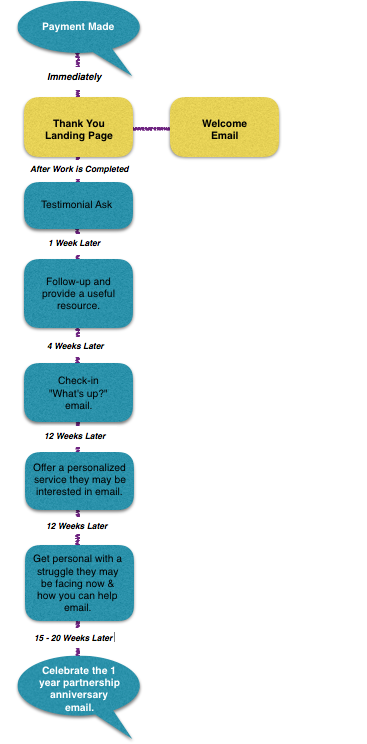
Welcome Them
This is a given.
Acceptance is a human desire we all crave. When there's a warm hello waiting in their inbox --it eases nervousness. Beyond the cold receipt. You can achieve this in a welcome email and/or re-direct them to a private thank you landing page.
Celebrate Them
Working with you warrants a celebration.
Together you are tackling a fear. Fear of losing money, running out of time, being devalued, not standing out, getting what they *really* want, or failing. Whip out the champagne flutes and make a personal toast. You can achieve this by sharing what experience they can expect from you.
Reassure Them
They're in good hands.
You have their best interest. You will not disappear once the cheque clears. Show up immediately after and months later to show, they've made the right decision. You can achieve this by telling them what's next, so they're not second-guessing or emailing you for details. You can follow-up with things they've discussed and needed help with by sharing articles, linking resources or bundling something special from your service.
On average, loyal customers are worth up to 10x as much as their first purchase. A well-crafted email can get you in the door, a thoughtful one can get you repeat business. All a customer wants in the end, is to not turn up like rotten prey meat but experience an orgasmic syrupy sweet.
My man, Hughes.
Ex. Email Flow Chart of the After Purchase Experience
For five years, people heard “copyright-er” when I said copywriter. Why expertise makes you hard to explain, and the one question that gets your regulars to explain you instead.
I can operate like I have a team of five, and sleep like I only have one.
Pinterest Predicts? More like Pinterest Programs.
ai is coming for your job. But first, it’ll colonize your expertise.
The cost of being remarkable is discomfort. The cost of being comfortable is irrelevance.
And I finally got the memo: work will never grieve you.
There is no innovation in stagnation.
You were chosen, so stop acting like you need permission to belong.
Predictions are for clickbaits. Preparation is for power moves.
If you don’t look the part, your confidence is labeled as cocky, your boldness as insubordination, and your assertiveness as aggressiveness.